Ever wondered why one truckload sometimes means 26 pallets and other times 30? Misjudge it, and you’re not just short two pallets—you might be paying for a whole extra truck.
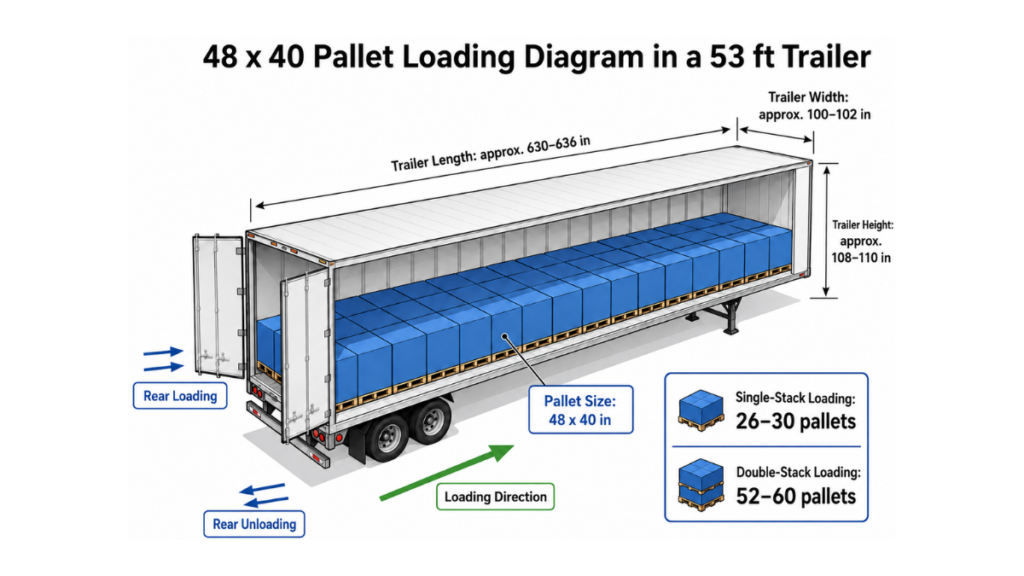
A standard 53-foot dry van typically fits 26 standard 48″ × 40″ pallets in a conventional single-layer layout. Depending on the trailer’s usable interior dimensions and pallet orientation, some loads may fit 28 or up to 30 floor positions. A conventional 26-position load can carry up to 52 palletized units when the cargo is safely double-stackable, but payload, axle weight, loaded height and product strength may reduce the actual count.
The difference is how pallets are sized, placed, and stacked. In this guide, we’ll show you the real math behind truck capacity, the loading methods that squeeze in extra rows, and the hidden limits like overhang or weight laws.
- Quick View About 48×40 Pallets Fit in Different Trucks
- What Loading Methods Determine Pallet Capacity?
- How Many Pallets Fit on a 53-Foot Truck?
- How Many 48×40 Pallets Fit In a 53-Foot Truck?
- How Many 42×42 Pallets Fit In a 53-Foot Truck?
- How Many 48×48 Pallets Fit In a 53-Foot Truck?
- How Many 40×48 Pallets Fit In a 53-Foot Truck?
- How Many 48×45 Pallets Fit In a 53-Foot Truck?
- How Many 36×36 Pallets Fit In a 53-Foot Truck?
- How Many Euro Pallets (48×32) Fit In a 53-Foot Truck?
- How Many Pallets Fit on a 48-Foot Trailer?
- How Many Pallets Fit on a 26ft Box Truck?
- How Many Pallets Fit in a 22-Foot Box Truck?
- How Many Pallets Fit in 16ft, 24ft, 40ft, and 45ft Trucks?
- How to Calculate Pallet Capacity for Any Truck Size?
- Other Factors That Limit Pallet Loading
- Conclusion
Quick View About 48×40 Pallets Fit in Different Trucks
| Equipment | Conventional single-layer count | Possible optimized single-layer count | Geometric double-stacked count |
| 53 ft dry van | 26 | Up to 30 | 52 to 60 |
| 48 ft trailer | 24 | Up to 28 | 48 to 56 |
| 26 ft box truck | 12 | Up to 14 on a suitable body | 24 to 28 |
| 24 ft box truck | 12 | Up to 14 on a suitable body | 24 to 28 |
| 22 ft box truck | 10 | Up to 12 on a suitable body | 20 to 24 |
| 16 ft box truck | 6 | Up to 8 on a suitable body | 12 to 16 |
| 40 ft intermodal container | 18 | Up to 20 with a mixed layout | 36 to 40 |
| 45 ft high-cube container | 22 | Up to 24 with a mixed layout | 44 to 48 |
There isn’t one pallet count that works for every truck. You can use this table if you’re loading standard 48″ × 40″ pallets with no cargo overhang and can use the full cargo space. If you want to double-stack, just make sure you have enough height and payload and that your cargo is safe to stack.
What Loading Methods Determine Pallet Capacity?
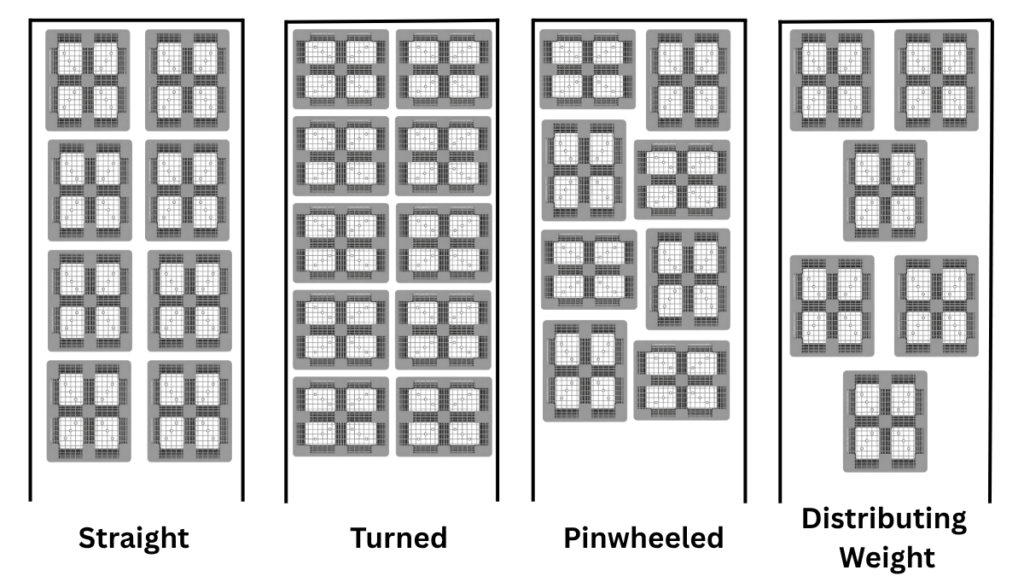
The way pallets are placed inside the truck explains why the number changes. Each method uses space differently and may need different equipment.
Straight Loading
Pallets face lengthwise, with the 48-inch side along the truck. Two pallets sit side by side, row after row. Any pallet jack can handle this, which makes it the most common style. But unused width means fewer rows fit compared to other layouts.
Sideways Loading
The 40-inch side faces the truck length. This lets you squeeze in more rows within the same space. Block pallets work well, but stringer pallets need a forklift or jacks with side forks. It improves capacity but adds handling limits.
Pinwheel Loading
Rows alternate between straight and sideways, forming a “pinwheel.” It closes gaps and gains a couple of extra pallets. The method saves space but slows loading speed, and it requires more careful placement to avoid misalignment.
Stackable Loading
When goods are stable and the roof height allows, pallets can be stacked in two layers. A 53ft trailer that holds 26 on the floor can carry 52 stacked. It’s efficient, but only safe if products can take the weight and weight limits are respected.
But for double-stacking, the lower pallets and cargo must be able to support the weight of the upper load. If they cannot handle the weight, cartons may be crushed, pallets may bend, or the cargo may shift during transit.
Both layers must also pass through the trailer door and stay within the trailer’s interior height.
Before loading, check the total cargo weight and the weight of each pallet, and leave enough room for load bars, straps, and other securing equipment. If the layout uses every last inch of space, you may not be able to secure the cargo safely.
How Many Pallets Fit on a 53-Foot Truck?
Figuring out how many pallets you can load into a 53-foot truck is crucial for planning your shipments and controlling costs. The answer depends on your pallet size and how you arrange them. Let’s walk through the most common scenarios to help you maximize your truck space.
First, here are the basics: First, here are the basics: A standard 53-foot trailer offers approximately 630–636 inches in length, 100-102 inches in width, and 108-110 inches in height. These measurements tell you whether the pallets fit on the floor. They do not tell you whether the truck can legally and safely carry the load. Many standard 53-foot dry-van shipments have an available cargo payload of roughly 42,000 to 45,000 lb, depending on the tractor, trailer, and fuel weight. A dense load may reach its allowable payload or axle limit while several floor positions are still empty.
Now let’s see how different pallet sizes fit inside. Exact usable dimensions vary by trailer model, wall construction, bulkhead, and door design. Now let’s see how different pallet sizes fit inside.
How Many 48×40 Pallets Fit In a 53-Foot Truck?
The 48×40 pallet (also known as the GMA pallet) is North America’s most popular size. You’ll typically fit 26 to 30 pallets per truckload in a single layer, or up to 52-60 pallets when double-stacked.
Straight Loading (26 pallets)
Place each pallet with its 48-inch side parallel to the trailer’s 636-inch length. This means the pallet’s longer dimension aligns with the truck’s longer dimension. You can fit 2 pallets side-by-side across the 102-inch width, and 13 rows fit lengthwise. This gives you 2 × 13 = 26 pallets total.
Pinwheel Loading (28 pallets)
By alternating pallet orientations—mixing long-side-forward and short-side-forward placements—you can fill those awkward gaps more efficiently. This pattern typically yields around 28 pallets.
Turned Loading (30 pallets)
Rotate every pallet 90 degrees so the shorter 40-inch side is parallel to the trailer’s 636-inch length. Now you can fit 15 rows instead of 13, giving you 2 × 15 = 30 pallets.
Double-Stacking
If you’re shipping lighter products on heavy-duty pallets, you might stack a second layer and reach up to 52 pallets. Just make sure your total height stays under 110 inches and your weight doesn’t exceed legal axle limits.
But if you’re using recycled material plastic pallets, we don’t recommend double-stacking them on top. Recycled pallets typically have a dynamic load capacity of no more than 1.5 tons, so they work best as bottom-layer base pallets only. For upper layers, choose virgin material pallets with higher load ratings to ensure safe transport.
How Many 42×42 Pallets Fit In a 53-Foot Truck?
The 42×42 pallet is square and commonly used in telecommunications, paint, and chemical industries. You can typically load 24 to 28 pallets in a 53-foot truck.
Straight Loading (24 pallets): Position pallets with one side along the trailer’s length. You’ll fit 2 pallets across the width and 12 rows lengthwise, totaling 2 × 12 = 24 pallets.
Optimized Loading (28 pallets): If the trailer provides at least 588 inches of clear interior length and 84 inches of usable width, you can place 2 pallets across and 14 rows lengthwise, totaling 2 × 14 = 28 pallets. Since 42×42 pallets are square, rotating them does not change the layout. Always check the loaded cargo overhang and the space needed for load securement before loading.
How Many 48×48 Pallets Fit In a 53-Foot Truck?
The 48×48 pallet is another square option, popular in drums, barrels, and bulk chemical shipping. You’ll generally fit 24 to 26 pallets per truck.
Standard Loading (24 pallets): With 2 pallets across and 12 rows deep, you get 2 × 12 = 24 pallets.
Tight Loading (26 pallets): By minimizing gaps and arranging pallets carefully, some shippers manage to squeeze in 26 pallets, though this requires precise placement and may not always be practical.
How Many 40×48 Pallets Fit In a 53-Foot Truck?
This is the same as the 48×40 GMA pallet, just with dimensions listed in reverse order. The loading capacity remains 26 to 30 pallets depending on orientation—refer to the 48×40 section above for detailed loading methods.
How Many 48×45 Pallets Fit In a 53-Foot Truck?
The 48×45 pallet is used in automotive and some grocery applications. You can typically load 26 to 28 pallets.
Straight Loading (26 pallets): Place the 48-inch side lengthwise. Two pallets fit across, and you’ll get about 13 rows, giving you 2 × 13 = 26 pallets.
Adjusted Loading (28 pallets): With careful arrangement and minimal gaps, some configurations allow for 28 pallets.
How Many 36×36 Pallets Fit In a 53-Foot Truck?
Smaller 36×36 pallets are used in beverage and dairy industries. You can fit significantly more—typically 32 to 36 pallets per truck.
Standard Loading (32 pallets): Two pallets across the width and 16 rows in length gives you 2 × 16 = 32 pallets.
Optimized Loading (34 pallets): With tight spacing and efficient arrangement, you may reach 34 pallets, maximizing your smaller footprint.
How Many Euro Pallets (48×32) Fit In a 53-Foot Truck?
A standard EUR 1 Euro pallet measures 1,200 × 800 mm, or approximately 47.24 × 31.50 inches. It is often rounded to 48×32 inches in general loading guides. You can typically load 30 to 33 Euro pallets in a 53-foot North American dry van.
Lengthwise Loading (30 pallets): Position the longer side along the trailer length. A conventional layout can hold about 30 pallets.
Mixed Loading (33 pallets): By alternating orientations strategically, you can sometimes fit 33 pallets. Confirm the trailer’s actual interior dimensions because a small difference in usable width or length can affect a tight 33-pallet layout.
How Many Pallets Fit on a 48-Foot Trailer?
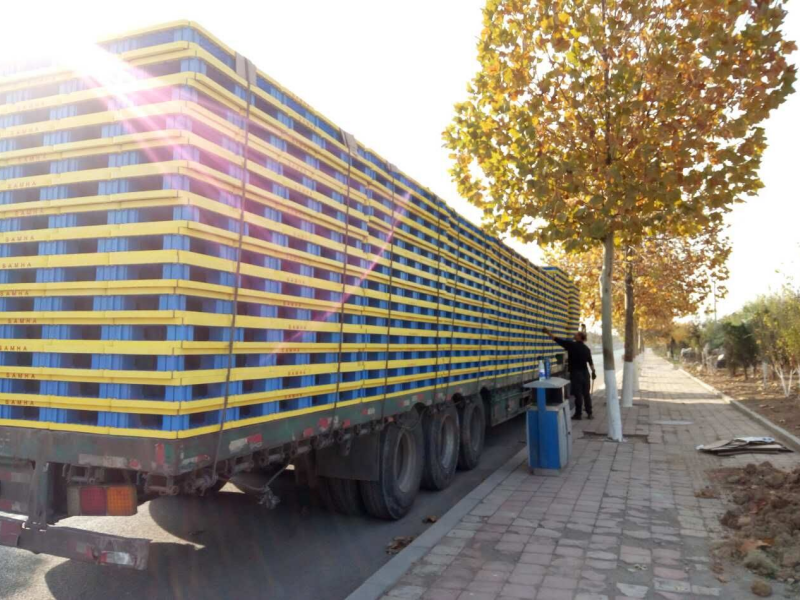
A 48ft trailer usually carries 24 to 28 standard 48×40 pallets. That is slightly fewer than a 53ft truck, which holds 26 to 30, because the trailer is 60 inches shorter.
Straight Loading: With the 48-inch side placed along the 576-inch length, two pallets fit across the 102-inch width. Twelve rows fit down the trailer, so the total is 24.
Pinwheeled Loading: Alternating the long and short sides helps close gaps. This pattern usually adds two more pallets, giving you 26 in total.
Sideways Loading: When the 40-inch side faces the trailer length, 14 rows can fit instead of 12. That makes the count 28, which is the maximum in a 48ft trailer without stacking.
How Many Pallets Fit on a 26ft Box Truck?
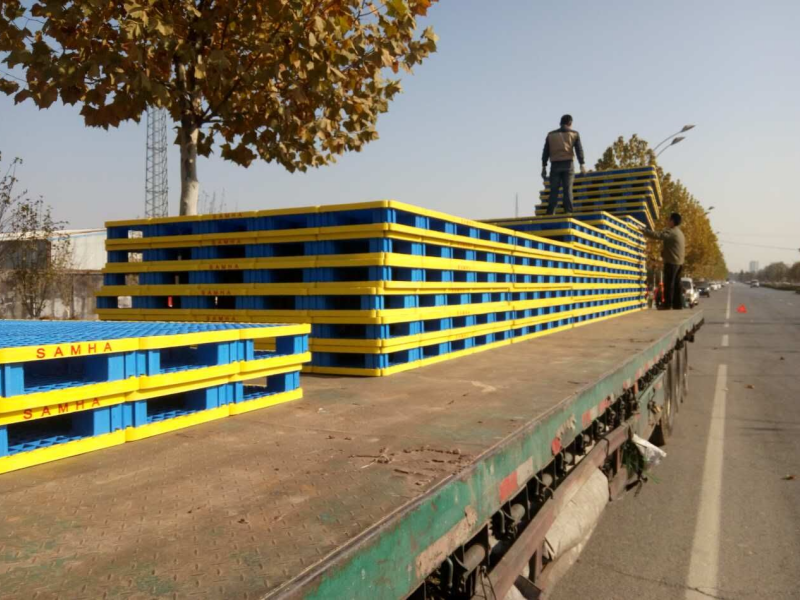
A 26ft box truck usually carries 12 to 14 pallets in one layer, or 24 to 28 pallets if stacked. It is smaller than long-haul trailers and is often used for local deliveries, so planning space well makes a big difference.
Single Layer
The trailer length is 312 inches. With pallets set at 48 inches long, six rows fit. Two pallets across the 96-inch width give you 12 total. If you rotate them so the 40-inch side faces forward, seven rows fit, reaching 14 pallets.
Double Layer
If pallets are heavy-duty and goods are stable, you can place another layer. This doubles the load to 24–28 pallets, but only if total height stays under the 96-inch roof and the weight is within limits.
Empty Pallets Only
When shipping pallets themselves, stacking changes the math. With each pallet about 6 inches thick, you can load 192–224 empty pallets in a 26ft truck.
Safety and Efficiency
Stacking saves space, but only when products are stable. Always leave clearance under the roof and balance the weight. For short-haul trucks like the 26ft, also keep in mind that easy loading and unloading is often more valuable than squeezing in one extra pallet.
How Many Pallets Fit in a 22-Foot Box Truck?
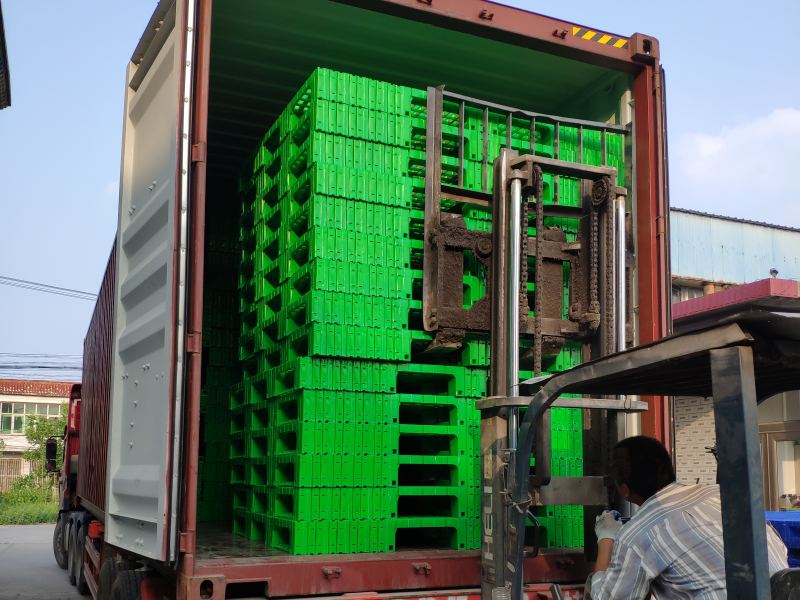
A 22-foot box truck usually fits 10 standard 48″ × 40″ pallets in a conventional lengthwise layout. If you have close to the full 22 feet of usable cargo length and at least 96 inches of clear interior width, turning the pallets can increase the count to 12 pallets.
Before you plan around 12 pallets, don’t rely on the “22-foot” label alone. Box-truck bodies vary by manufacturer, and wheel wells, a front bulkhead, or liftgate equipment can quietly take away usable space. A narrower rear door can even stop a pallet from entering when the floor space inside looks large enough. Check the clear interior dimensions, door opening, and payload rating before loading. Otherwise, you may have to leave a pallet behind or switch trucks at the last minute.
How Many Pallets Fit in 16ft, 24ft, 40ft, and 45ft Trucks?
Not every shipment goes into a 53ft or 26ft truck. Medium box trucks and international containers are also widely used in freight. The numbers below show single-layer capacity only, based on standard 48×40 pallets without stacking.
| Truck / Container | Pallet Count (Single Layer) | Notes |
| 16ft Box Truck | 6–8 pallets | Local delivery, limited space |
| 24ft Box Truck | 12–14 pallets | Often used in regional transport |
| 40ft Container | 18–20 pallets | Standard in ocean shipping |
| 45ft Cube Container | 24–26 pallets | More space than 40ft, used for international routes |
Can You Fit 12 Pallets in a 24-foot Box Truck?
Yes, many 24-foot box trucks can fit 12 standard 48″ × 40″ pallets in a single layer, arranged as two pallets across and six rows. Before booking, confirm that the truck has enough clear interior length and width and that all loaded pallets can pass through the rear door.
A turned layout may create up to 14 floor positions in some bodies, but this is not available in every 24-foot truck. Wheel wells, liftgate equipment, pallet overhang, and the truck’s payload rating can reduce the practical count.
| Pallet Size | 53ft Trailer | 48ft Trailer | 26ft Truck | Notes |
| 48×40 (GMA) | 26–30 (52-60 stacked) | 24–28 | 12–14 (24–28 stacked) | Most efficient, supports all loading patterns |
| 48×48 | 26 | 24 | 12 | Square shape, no gain from pinwheel |
| 42×42 | 24-28 | 28 | 14 | Square but smaller footprint, higher count |
| 48×45 | 26–28 | 24–26 | 12–13 | Wider footprint, common in automotive |
How to Calculate Pallet Capacity for Any Truck Size?
If you ever want to figure it out yourself instead of checking a chart, the math is simple. With just the truck’s inside dimensions and the pallet size, you can get a quick answer.
Formula (single layer):
(Truck length ÷ Pallet length) × (Truck width ÷ Pallet width)
For stacking:
Single layer result × (Truck height ÷ Pallet height)
Example for 53ft truck with 48×40 pallets:
- Length: 636 ÷ 48 = 13 rows
- Width: 102 ÷ 40 = 2 pallets across
- Single layer = 13 × 2 = 26 pallets
- With stacking (110 ÷ 48 ≈ 2 layers): 52 pallets
This way, you can check any truck size in seconds, as long as you know the inside length, width, and height.
Other Factors That Limit Pallet Loading
You may already know pallet size and stacking change the numbers, but they’re not the whole story. In real shipping, weight, overhang, and legal limits often decide whether all those pallets can actually fit.
Weight Restrictions: A truck may “weigh out” before it “cubes out.” Heavy goods can hit the legal weight limit with fewer pallets.
Pallet Overhang: If boxes extend even 2–3 inches beyond a pallet, an entire row may not fit, forcing you to remove pallets.
Safety and Compliance: Axle load balance, roof clearance, and door access all matter. Overloading or poor distribution risks fines, accidents, and damaged goods.
Conclusion
A standard 48×40 pallet usually means 26–30 in a 53ft truck, 24–28 in a 48ft, and 12–14 in a 26ft box truck. These numbers define what a full load really is and give you a clear baseline for planning. Knowing how many pallets fit on a truck is not just about numbers—it’s about saving freight costs, protecting goods, and planning with certainty.
As a plastic pallet manufacturer, we help you match plastic pallet design with truck space, so you move more with less. Custom sizes, fair pricing, and durable products mean no wasted spend and no shipping guesswork.
👉 Contact us today for a tailored quote and pallet solution that fits your load and your budget.