Whether you handle aluminum cans, glass bottles, PET bottles, or shrink-wrapped beverage packs, your pallet affects more than storage. It can affect production flow, hygiene control, packaging damage, and handling cost.
Wood pallets have been used in beverage plants for years. But in wet, high-frequency, and automated operations, they can bring problems such as moisture absorption, mold risk, splinters, exposed nails, unstable dimensions, and extra export steps under ISPM-15.
This is why more beverage plants are moving to plastic beverage pallets. In this guide, we explain the main benefits, common beverage pallet dimensions, and how to choose the right pallet for your operation.
8 Key Reasons Beverage Plants Choose Plastic Pallets
1. Plastic Pallets Are Cleaner
Beverage production must runs under strict requirements: FDA, HACCP, BRC, local health inspections. If you work in the beverage supply chain, the last thing you want is an auditor flagging your pallets during a facility inspection or customer visit.
Wood pallets absorb moisture, which leads to mold. They shed debris — wood chips, splinters, loose fibers — that can get into packaging or onto product contact surfaces.
Plastic pallets don’t have these issues. The surface is non-porous, so moisture stays on top and washes off. There’s nothing to splinter, nothing to absorb, nothing for mold to grow in. For your beverage plant, this makes daily hygiene control much easier.
2. Your Packaging Stays Intact
Aluminum cans, glass bottles, cartons, and shrink-wrapped packs are easy to scratch, dent, or puncture during handling. Wood pallets may look smooth at first. But after repeated forklift use, moisture, and heavy loads, nails may come out, and the surface may become rough or splintered.
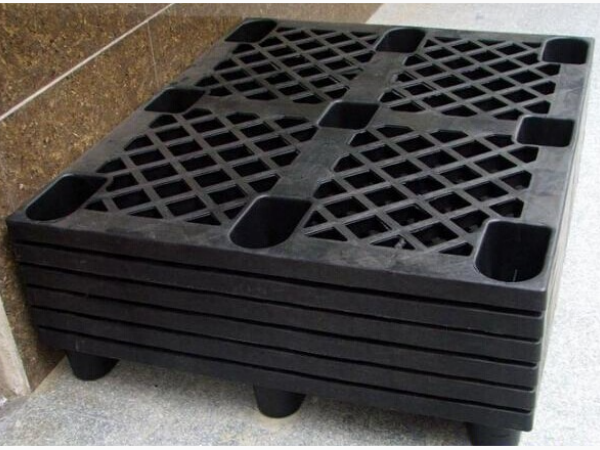
Plastic beverage pallets are smooth and nail-free. HDPE/PP is also tougher in wet and busy handling areas. When the pallet is hit or pressed by heavy beverage loads, it is less likely to split like wood.
Even if a plastic pallet gets a small impact mark, the damage usually stays in one area. Small burrs can be trimmed, and rough marks can be smoothed. You do not need to keep fixing loose boards, exposed nails, or cracks that keep getting worse.
That helps reduce packaging damage, pallet repair work, and sorting time.
3. Better for Conveyor Lines
If you use automated equipment, such as conveyors, palletizers, AGVs, or AS/RS, pallet damage can quickly affect your production flow.
Wood pallets may start flat, but after long use, they can warp, bend at the edges, or become seriously deformed. When this happens, the pallet may get stuck on the conveyor, fail to enter the palletizer smoothly, or trigger system errors. In the end, you may have to stop the line and deal with the pallet problem first.
Plastic beverage pallets are more stable in this kind of operation. Materials like HDPE are not sensitive to normal changes in moisture and temperature, so the pallet keeps its shape better during daily use. This helps reduce pallet jams, handling errors, and unplanned line stops in your beverage plant.
4. Better for Wet Areas
In beverage plants, filling, rinsing, sterilizing, cooling, and floor cleaning happen every day. So your pallets often work around water vapor, wet floors, and condensation.
Wood pallets do not handle this well. They can absorb water from wet floors, steam, and condensation. After long use, they may swell, warp, grow mold, or lose load stability.
Plastic beverage pallets are a better fit for these areas. HDPE/PP does not absorb water, so the pallet will not swell or mold like wood. In particular, our beverage pallets can work stably from -40°C to 70°C. You can use them near filling lines, washing areas, cold storage, finished goods warehouses, and daily handling zones.
5. Lower Cost Per Use Over Time
Plastic pallets cost more at the first purchase. We will not hide that.
But in a beverage plant, you should not only look at the unit price. Your pallets move every day between production lines, warehouses, cold storage, trucks, and customer return loops. One pallet may be used hundreds of times in a closed-loop system.
In our beverage customer projects, we often hear one clear problem: wood pallets do not stay reliable for long in wet, high-frequency use. Many customers tell us their wood pallets may only last around 10–15 trips before repair, sorting, or replacement. Our plastic pallets can reach 200+ trips in repeated-use supply chains when they are used correctly.
That is why the real question is not:“How much does one pallet cost?”
The better question is:“How much does one pallet cost each time we use it?”
For example, if a plastic pallet costs more upfront but stays in daily use for 8 years, your cost per use becomes much lower than replacing wood pallets every 12–18 months. You also reduce repair work, broken pallet sorting, disposal cost, and downtime caused by pallet failure.
For beverage plants with fast pallet rotation, this difference matters a lot. Your pallets do not sit still. They go through filling areas, forklifts, stacking, loading docks, and return cycles every day. The longer each pallet stays usable, the lower your real handling cost becomes.
6. Stable for Heavy Beverage Loads
Beverage loads are heavy. A full pallet of bottled water, canned drinks, beer, or juice often weighs around 800–1,200 kg.
A standard wood pallet can look strong when it is new. In a dry and evenly loaded test condition, it may reach about 2,000–4,000 kg static load. But your beverage plant is not a dry test room.
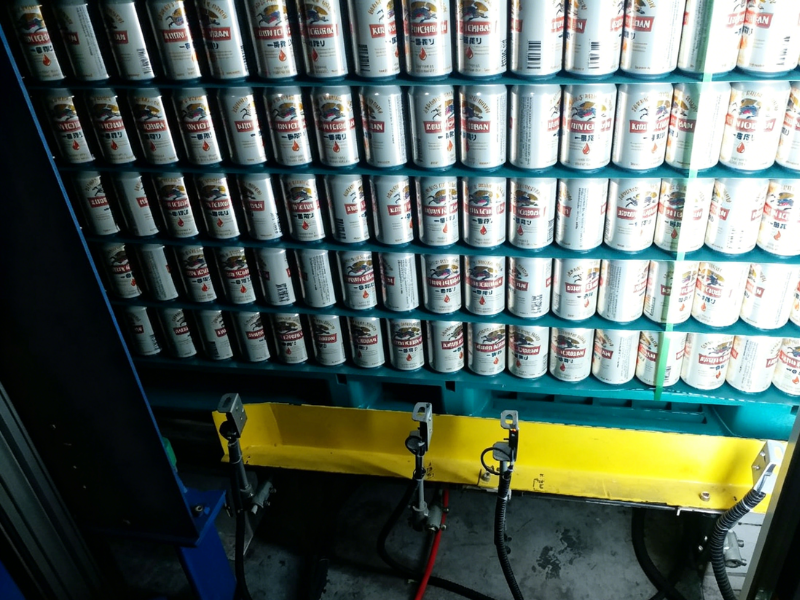
Your pallets work on wet floors. They face condensation, forklift handling, stacking pressure, and daily movement. After some time, wood pallets may start to bend, crack, or loosen. Once that happens, the load rating on paper no longer gives you the same safety in real use.
Our plastic beverage pallets are built with a one-piece molded structure, dense reinforcing ribs, and stronger bottom support. For heavier beverage loads or racking use, we can add steel tubes inside the pallet to increase load capacity and reduce bending during long-term use.
For example, we can recommend different models based on your real load:
- 1,000–2,000 kg dynamic load for forklift handling and daily movement
- 4,000–6,000 kg static load for floor stacking and warehouse storage
- 500–1,500 kg rack load for beam racking, depending on pallet structure and steel reinforcement
So you are not choosing a general pallet and hoping it works. We help you match the pallet structure to your beverage load, forklift use, stacking height, and rack system. That is how your full beverage pallets stay more stable in daily operation.
7. Easier Pallet Sorting with Color
Beverage plants move a large number of pallets every day. Your pallets may go from production lines to cold storage, finished goods warehouses, loading areas, and customer return loops.
If every pallet looks the same, sorting becomes slow. Workers need to check where the pallet came from, what it carries, and where it should go next.
Wood pallets are also hard to manage by color. You can paint them, but paint is only a surface treatment. After repeated forklift handling, washing, stacking, and daily movement, the paint may wear off, peel, or become dirty. This can create extra hygiene concerns around your production and storage areas.
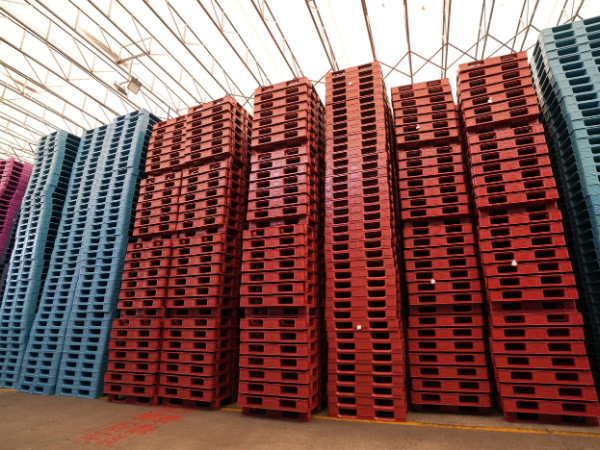
Plastic beverage pallets make sorting much easier. We can produce your pallets in different colors during the molding process. The color is part of the plastic material, not a coating added later. So it will not peel like paint, and it will not create extra surface contamination for your beverage handling area.
Different colors help your team sort pallets by area at a glance. This makes daily pallet sorting faster. Your workers can see the pallet type right away, reduce wrong-area use, and keep your pallet flow cleaner and easier to control.
We recommend that you use these colors to correspond to your factory zones:
- Blue for production
- Red for returns
- Green for finished goods
- Gray for cold storage or export
8. Ready for RFID Tracking
If you need to track pallet numbers, cycle times, warehouse positions, or customer return status, wood pallets can be hard to manage.
You can add labels or RFID tags to wood pallets later, but they are usually fixed on the surface. In daily beverage handling, this surface can get wet, dirty, scratched, or damaged by forklifts. Labels may fall off. Tags may break.
Plastic beverage pallets are easier to design for tracking from the start. We can reserve RFID positions during mold design, or build embedded RFID areas into the pallet structure. These positions are usually placed away from the main impact areas, so the RFID tag is less likely to be hit or damaged during forklift handling, washdowns, stacking, and long-term rotation.
With RFID or barcode tracking, you can connect each pallet with its own ID, cycle count, storage position, loading area, customer return status, and maintenance record.
For your daily operation, that means less manual checking, fewer lost pallets, faster inventory counts, and better control over your reusable pallet assets.
Common Beverage Pallet Dimensions
Beverage pallets do not have only one standard size. The right size depends on your market, beverage packaging, palletizer, conveyor line, forklift, racking system, and loading weight.
European beverage plants often use 1200 × 800 mm and 1200 × 1000 mm pallets. These sizes are easy to match with European storage, retail, and transport systems. EPAL also lists 800 × 1200 mm, 1200 × 1000 mm, 1000 × 1200 mm, and 800 × 600 mm as common pallet formats, which makes them useful references for European beverage logistics.
For North American beverage distribution, 48″ × 40″ is the most common general pallet size. Beverage plants may also use 48″ × 36″ and 36″ × 36″ for specific drink handling, bottled water, and regional delivery systems.
For Australia and New Zealand, 1165 × 1165 mm is an important size to check before you order pallets. If your beverage products go into the Australian supply chain, this size may help you fit local warehouse and transport systems more easily.
For aluminum cans and can-end handling, 1420 × 1120 mm is one of the most important beverage can pallet sizes. This size is widely used for empty cans, filled cans, can ends, and layer pad systems. ORBIS also describes its 1120 × 1420 mm beverage pallet as suitable for filled beverage products, aluminum and steel cans, glass, plastic bottles, and can ends on many palletizers and conveyor systems.
For can industry projects, we can also support 1300 × 1120 mm and 1250 × 1180 mm designs. These sizes are often used when your can layout, separator sheets, palletizer, or return loop requires a different footprint.
General Beverage Pallets By Packaging Type
| Beverage Product | Common Packaging | Pallet Sizes You May Need |
| Bottled water | PET bottles, shrink-wrapped packs, cartons | 1200 × 800 mm, 1200 × 1000 mm, 48″ × 40″, 48″ × 36″ |
| Carbonated drinks | PET bottles, aluminum cans, cartons | 1200 × 1000 mm, 48″ × 40″, 1420 × 1120 mm |
| Juice and tea drinks | PET bottles, glass bottles, cartons | 1200 × 800 mm, 1200 × 1000 mm, 48″ × 40″ |
| Beer | Glass bottles, cans, crates, cartons | 1200 × 1000 mm, 1200 × 1200 mm, 48″ × 40″, 1420 × 1120 mm |
| Aluminum cans | Empty cans, filled cans, can ends | 1420 × 1120 mm, 1300 × 1120 mm, 1250 × 1180 mm |
| 5-gallon water bottles | Returnable water bottles | 1090 × 1090 mm, 36″ × 36″, custom square layouts |
| Retail beverage display | Small packs, promotion packs | 800 × 600 mm, half pallet sizes |
Want the Full Spec Sheet? Contact us for a complete model recommendation.
How to Choose the Right Plastic Beverage Pallet for Your Operation
Don’t just focus on dimensions and price. Your pallets need to perform across production lines, palletizing equipment, forklifts, racking systems, cold storage, warehouses, and export transport. A mismatch at any stage creates bottlenecks.
First: Check Conveyor and Automation Compatibility
For highly automated beverage operations, we typically recommend solid-top plastic pallets. The flat surface gives consistent contact with conveyors, rollers, and chain equipment — no jams from uneven load distribution.
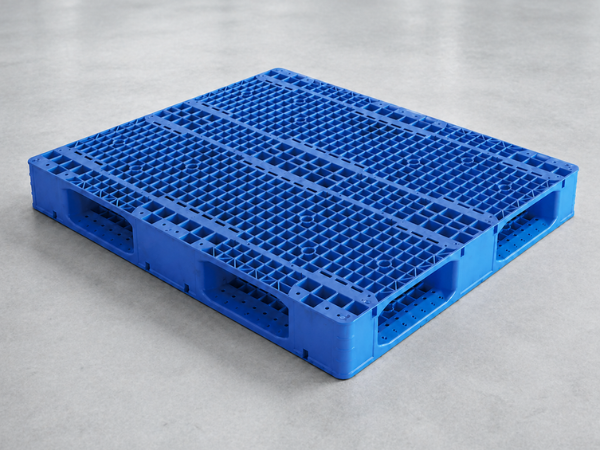
For facilities with high humidity or pallets moving through washing areas and wet floors, mesh-top plastic pallets are better. The open deck drains immediately and ventilates well during continuous rotation.
For Racking: 1200 × 1000 × 150 mm Is Your Reliable Default
When your beverage products go into racking systems, you need to evaluate rack load capacity, runner structure, and beam contact area — not just static load.
For most beverage facilities, 1200 × 1000 × 150 mm handles finished goods storage, forklift handling, rack storage, and export. It supports heavy bottled water, canned beverages, juices, and beer loads well.
For higher palletized weights or long-term rack storage, we can analyze your rack type, beam spacing, pallet entry direction, and total load to recommend three-runner, six-runner, double-sided, or steel-reinforced configurations.
For Export: Match Your Target Market’s Standard
Beverage exports need more than load compatibility — your pallet dimensions need to fit the destination’s warehouse and retail systems.
- European markets: 1200 × 800 mm and 1200 × 1000 mm
- North American markets: 48″ × 40″, 48″ × 36″, and specialized beverage dimensions
- Australian markets: 1165 × 1165 mm and locally preferred specifications
If you’re exporting to multiple countries, confirm warehouse systems, retail requirements, container loading methods, and customer receiving standards before you order. Re-palletizing on arrival is expensive and avoidable.
Material Safety for Food and Beverage Applications
Plastic pallets for food and beverage should use HDPE or PP with confirmed raw materials, colorants, and additives that meet your food-grade and regulatory requirements.
We provide full documentation on material safety — HDPE/PP composition, colorant compliance, FDA, ROHS, REACH, SGS, CE, and ISO 9001 certification — so you have what you need for customer audits and export compliance.
How Our Plastic Beverage Pallets Performed in the Field
Coca-Cola Bottlers — High-Frequency Rotation in East Africa
We’ve supplied plastic beverage pallets to multiple bottler companies within the Coca-Cola system — including Coastal Bottlers in Mombasa, Nairobi Bottlers, and Almasi Beverages in Nairobi.
These facilities needed pallets that could handle not just warehousing, but production line transfers, finished goods stacking, forklift handling, and distributor delivery — all in high-humidity East African environments where wood pallets deteriorated quickly.
Solution: 1411 mesh double-sided plastic pallets. The double-sided construction provides stability during stacking and repeated handling; the mesh surface drains immediately and ventilates during washdowns. The switch eliminated problems from wood pallet water absorption, mold growth, and dimensional instability that were previously disrupting production rhythms.
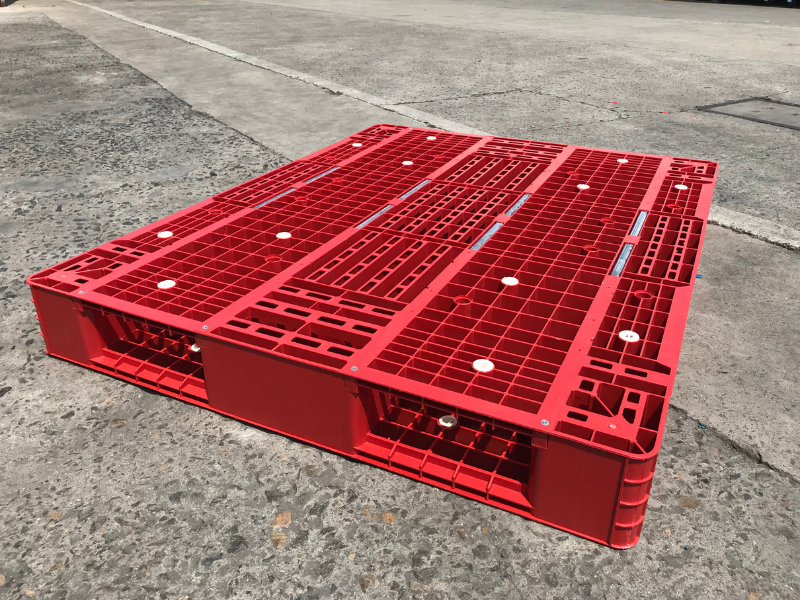
Dashen Beer Ethiopia — 20,000+ Pallets for a Major Brewery
Dashen Beer Ethiopia, one of the largest breweries in East Africa, needed a high-volume pallet solution that could handle beer’s demanding weight and rotation requirements.
The challenge: Beer products have high palletized weights and high rotation frequency. Standard pallets under sustained heavy loads, forklift handling, and stacking pressure develop deformation that compromises load safety.
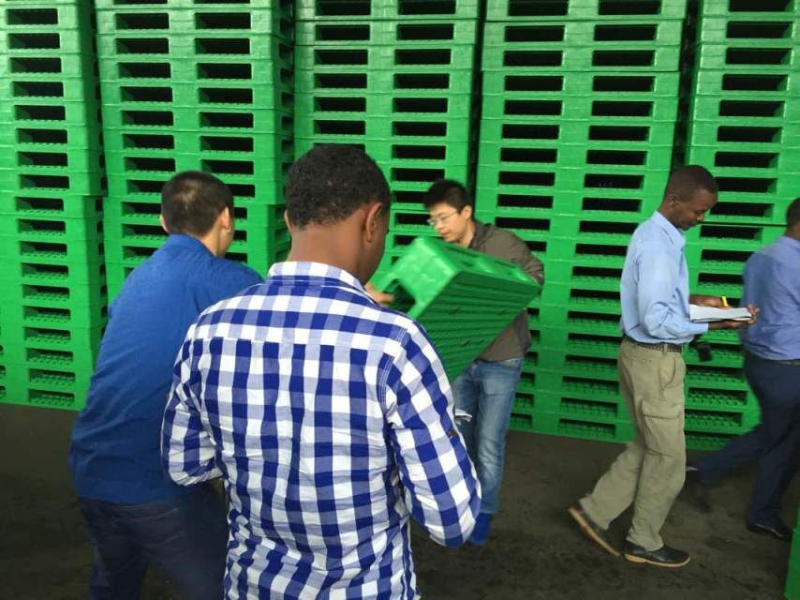
Solution: 20,000+ units of 1210 welded mesh double-sided plastic pallets with 8 steel tube reinforcements (6–8 kg reinforcement per pallet). The double-sided structure and steel tube reinforcement significantly improved overall load performance. Mesh construction suited the brewery’s moisture environment — no surface water accumulation, easy cleaning, reliable long-term rotation.
These pallets replaced wood across production, warehousing, and transportation — and the load performance remained consistent throughout.
Pepsi Cola — Aluminum Can Industry Pallet Solution
We’ve provided beverage can pallet solutions for Pepsi Cola operations in Ethiopia and Shanghai — addressing the specific challenges of empty can handling.
The challenge: Empty aluminum cans have low individual weight but large volume and are easily deformed. Dimensionally unstable pallets or uneven surfaces affect stacking effectiveness and downstream production line integration.
Solution: 1420 × 1120 × 120 mm pallet + separator system designed specifically for empty can stacking and transport. The large-dimension pallet works with separators to maintain stable empty can configuration during multi-layer stacking, reducing tilting, compression, and deformation.
For can industry customers, the priorities are dimensional stability, surface flatness, and automation compatibility — and this configuration delivers on all three.
FAQ About Beverage Pallets
How many beer cases fit on a pallet?
A 1200 × 1000 mm pallet usually holds 56–96 beer cases, based on 7–8 layers. A 48×40 pallet can hold 72 to 100 cases of beer, depending on carton size, stacking pattern, and load height. For an exact layout, send us your case size and bottle type.
What is a beverage pallet?
A beverage pallet is specially used for the production, handling, temporary storage, and transport of bottled or canned beverages. Compared with pallets used only for simple stacking, beverage pallets need better water resistance and higher dimensional accuracy, so they can fit your automated systems and prevent the pallet from becoming damp.
Are there plastic pallets for 5-gallon water bottles?
Yes. For 5-gallon bottled water, we recommend modular plastic pallets with fixed bottle positions. They can help keep round water bottles stable during handling, stacking, and delivery. One pallet can usually carry 24–40 bottles or more, depending on bottle size, pallet layout, and stacking method.
What certifications do your plastic beverage pallets have?
Enlightening Pallet beveragepallets are certified to ISO 9001, SGS, FDA, CE, ROHS, and REACH standards. Full documentation is available for customer audits and export compliance.
Ready to Find the Right Beverage Pallet for Your Operation?
Start with our Plastic Pallets for Beer and Beverage Industry product page. You can quickly review proven pallet models for production lines, cold rooms, racking, storage, and export transport.
Need more options? Contact our experts directly. Our sales team will check your load weight, pallet size, handling equipment, racking system, and beverage packaging type, then recommend suitable stock models not shown on the page.
Need a special size, can layout, or automation fit? Our engineering team can provide custom pallet mold design support within 48 hours.