There are many costs in your supply chain that are hard to control—freight, labor, warehousing—and any one of them can quietly eat into your margin. But there’s one cost you might be overlooking: your pallets.
If you’re still using wooden pallets, you’ve probably gotten used to the reality—frequent breakage, constant repairs and replacements, and prices that go up and down with the market. On top of that, wood pallets come with limits in hygiene, automation systems, and international shipping compliance, all of which slowly drive up your overall supply chain cost.
Now, you’ve probably heard that plastic pallets cost more upfront. That’s true. But once you factor in service life, damage rates, cleaning costs, storage efficiency, and transport loss, the long-term cost of plastic pallets is often lower—and far more predictable. Keep reading to see why we’re confident plastic pallets can help you take control of your supply chain costs.
Lower Total Procurement Cost
First, it must be clarified that the initial purchase cost of plastic pallets is definitely higher than that of wood pallets, but try looking at it from another perspective: assuming in your facility, over a 3-year usage period, a heavy-duty wood pallet costs about $25, while a standard industrial stackable plastic pallet costs about $42. Under high-frequency handling, export, or humid environments, wood pallets usually approach end-of-life by the third year, while a properly used plastic pallet can continue to operate reliably for another 5–7 years after year three.
Let’s break the cost down:
Wood pallet: $25 ÷ 3 ≈ $8.33 / year
Plastic pallet: $42 ÷ 10 = $4.20 / year
It’s clear that the annual cost of plastic pallets can be 40%–50% lower than wood pallets. And this is only the “visible cost”—let’s look further into the losses and operational costs.
Less Frequent Repair and Replacement
You likely do not want hidden costs to keep appearing in your warehouse. But when wood pallets fail during daily use, they often bring exactly that problem.
Wood pallets tend to break boards, lose nails, and crack during use, especially after impact from handling equipment or drops from height. If your supply chain scale is large, you may have hundreds to thousands of pallets, and especially if you have not yet switched to plastic pallets, this can mean dealing with pallet failures almost every day.
These failures usually create three hidden costs for you:
- Repair labor costs
- Downtime waiting costs
- Replacement procurement costs
We can confidently tell you that plastic pallets will not demand your attention in the same way during operations. Because they are one-piece molded, they can withstand impacts and drops. You don’t need to arrange daily inspections, and you don’t need to stockpile replacement pallets years in advance.
Now let’s compare the pallet replacement frequency you are concerned about:
- Wood pallets: typically require repair or replacement every 10–15 cycles
- Plastic pallets: can typically run 200+ cycles without repair, and our reinforced models can even reach 500+ cycles
By now, you can probably already see why plastic pallets offer clear advantages. That said, if proper palletizing and stacking practices are not followed, pallet life can still be reduced early during storage, and its performance in later handling, transport, and circulation can also be affected. You can read our How to Stack Pallets to learn the right way to stack pallets and the key precautions you should know.
Lower Transportation Cost
Another commonly underestimated factor is transportation cost (freight cost). Businesses can also reduce overall logistics expenses by working with reliable global shipping solutions providers that optimize transportation routes, customs procedures, and delivery methods.
Even if you can source cheaper pallets, it does not necessarily mean your freight costs will decrease significantly. What truly determines your transport cost per shipment is loading efficiency—how much usable cargo you can fit into the same truck or container.
Let’s first take a look at the loading rate formula: actual loaded cargo volume or quantity ÷ available container volume or floor space
In simple terms, the higher your loading efficiency, the lower your freight cost per unit of cargo.
At the same time, pallets themselves affect loading efficiency in the following ways:
- Unstable pallet dimensions
- Inability to arrange pallets tightly
- Inability to support multi-layer stacking
- Loading loss due to pallet damage, warping, or moisture
- Inability to minimize safety gaps
Under ideal conditions, a 1200 × 1000 mm pallet in a 40HQ container can stack about 10 layers, with 9 cartons per layer, totaling about 90 cartons per pallet. However, in real operations, wood pallets vary in size and can deform, making it difficult to achieve ideal loading. Losing even one layer or one carton per layer can reduce capacity to 80–81 cartons per pallet.
Plastic pallets, being mold-formed with dimensional tolerance controlled within ±2 mm, are much closer to ideal loading conditions. Therefore, under the same loading conditions:
- Wood pallets: about 72–81 cartons per pallet
- Plastic pallets: about 90 cartons per pallet
This leads to a direct result: in the same 40HQ container, plastic pallets can improve loading efficiency by 5%–12%. If a container costs $2000 to ship, increasing load by 10% effectively reduces your per-shipment transport cost by nearly 10%. This saving far exceeds the price difference of the pallets themselves.
ISPM-15 Exemption
If you use wood pallets, they are generally subject to the International Standards for Phytosanitary Measures No. 15 (ISPM-15), requiring fumigation or heat treatment, along with IPPC marking before export. This step often creates 1–2 days of waiting time, sometimes longer, especially when arranged on short notice. This process is typically handled by pallet suppliers or third-party service providers, but the cost ultimately falls on you.
Now let’s look at plastic pallets. Plastic pallets are completely outside the ISPM-15 regulatory scope. This means that once your cargo is loaded, it can be shipped immediately. There is no risk of being held for quarantine inspection, and no additional marking is required. At the destination port, customs will not carry out phytosanitary inspections based on pallet material.
If you are a high-frequency exporter—for example, shipping dozens of containers per month—saving even two days per cycle compared to wood pallets becomes significant over time. Every shipment you send is saving time.
Space and Efficiency
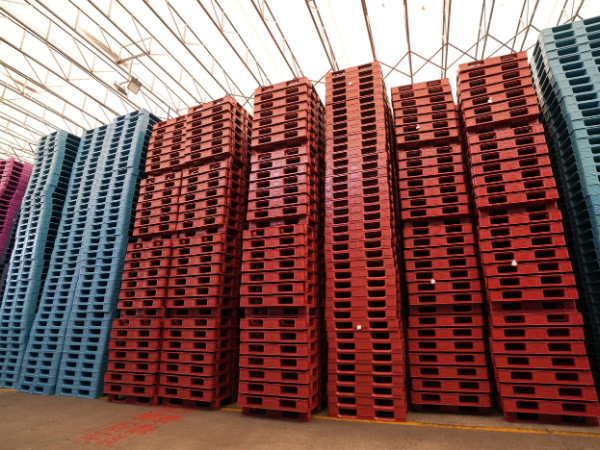
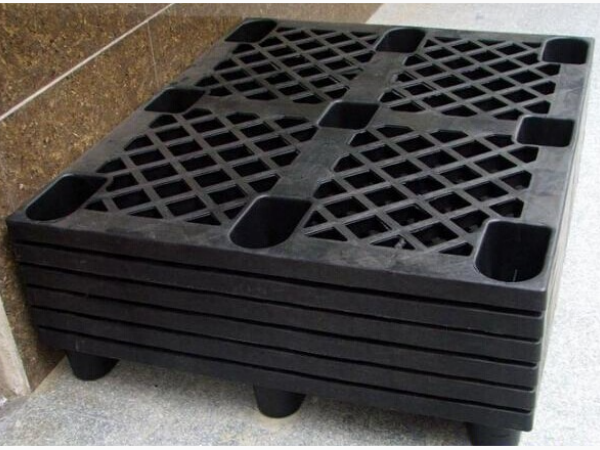
Plastic pallets can help you save space more effectively than wood pallets, and the difference is especially clear when you compare nestable plastic pallets with non-nestable wood pallets.
Let’s look at a simple example. Based on a 40HQ internal height of approximately 2690 mm, if you use a non-nestable pallet with a height of 150 mm, the maximum stack quantity is:
2690 ÷ 150 = 17 units
Now let’s look at a nestable pallet. The base height is also 150 mm, but after the first pallet, each additional pallet adds only 30 mm of pallet surface height. Under the same container height, the maximum stack quantity can reach:
85 units
So under the same container height, the comparison is very clear:
Non-nestable: 17 units
Nestable: 85 units
In other words, choosing nestable plastic pallets can reduce empty pallet volume by 75%.
This directly helps you in two ways. First, you can reduce the warehouse space needed for empty pallets. Second, if you need to return empty pallets, the lower volume can also reduce your return freight cost.
At the same time, plastic pallets also help improve handling efficiency. Because their dimensions are consistent and their structure is stable, they are better able to support stable multi-layer stacking. Even after 1–2 years of use, forklift handling can still remain smooth. Compared with wood pallets that are more likely to deform, your loading and unloading efficiency can typically improve by 10%–20%.
FAQ
What is the supply chain cost?
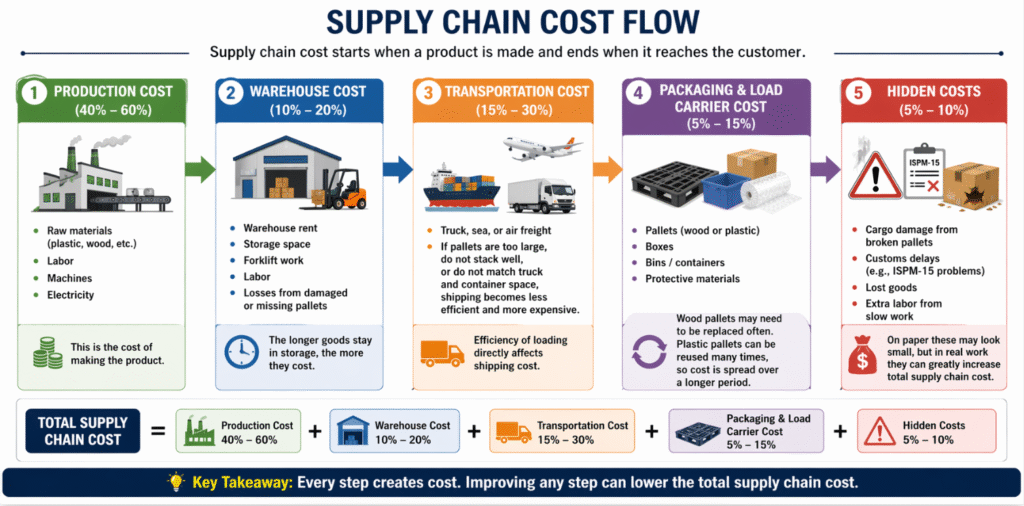
Simply put, supply chain cost refers to the cost from raw material sourcing and production, through warehousing, handling, Packaging, Load Carrier Management, transportation, and final delivery to the customer. As shown in the diagram:
In addition to these visible costs, there are also hidden costs such as cargo damage, delays, pallet loss, additional warehouse space demand caused by poor space utilization, and labor costs caused by low operating efficiency.
How many plastic pallets do I need to buy to start saving money?
It depends on your operation, but you usually start seeing clearer savings when you have enough pallets to support one full working cycle. Our MOQ of 300 units can usually cover your regular production, storage, or closed-loop export needs, while still leaving a few pallets available for replacement.
Do plastic pallets work with all types of forklifts and racking systems?
Most of our plastic pallet designs are compatible, but double-sided pallets are usually not suitable for pallet jacks, and nine-leg pallets are not suitable for racking systems. You should pay close attention to this when making a purchase.
What’s the difference between a one-way pallet and a reusable pallet for supply chain cost?
A one-way pallet is better for shipments where the pallet does not return after delivery. If your pallets move within a closed loop—such as between your warehouse, distribution center, or fixed buyers—a reusable plastic pallet will usually save much more over time.
Choose EnlighteningPallet to Reduce Your Supply Chain Costs
Our plastic pallets not only help you reduce your supply chain costs, but we also provide rackable pallets and hygienic pallets to match your specific requirements.
If you’d like to learn how plastic pallet solutions can improve your supply chain cost, feel free to call us at +86 150 6629 1772, send us an inquiry, or visit our factory in person.