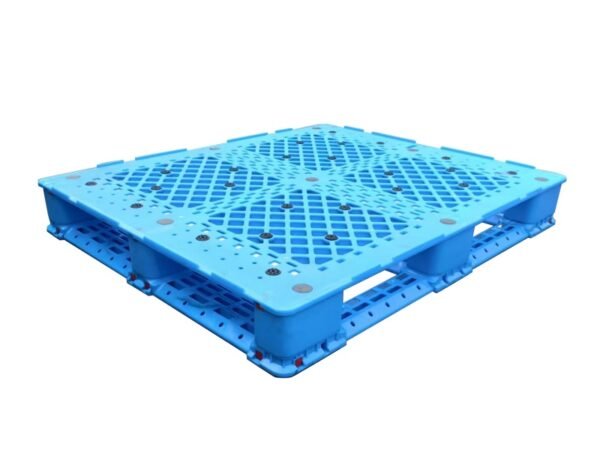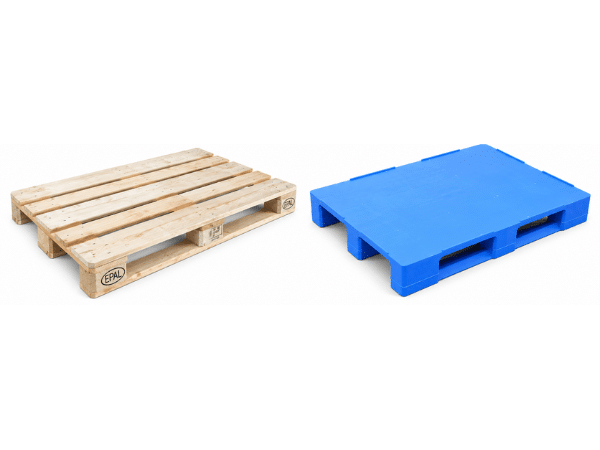
Euro pallets play an important role in European warehousing, truck loading, forklift handling, racking, and reusable logistics. However, Euro pallets come in many sizes, structures, and materials, so it can be difficult to match the right model with your actual application.
That is why we prepared this Euro Pallet Dimensions guide first. In this article, you will learn the standard Euro pallet sizes, the differences between Euro pallets, UK pallets, and US pallets, and how to choose the pallet type that suits your goods, warehouse, and transport needs.
Want to talk with us now? Use the chat window on this page or contact us in any way that is convenient for you.
What Are Euro Pallets?
Euro pallets, also called EUR pallets or EPAL Euro pallets, usually come in 1200×800mm size. Euro pallets are made from 2 materials: wood and plastic. Wooden Euro pallets are mainly used for storage, transport, forklift handling, and other jobs that match the normal European pallet flow. Plastic Euro pallets are used more in European meat production with higher hygiene needs, and in high-frequency return use.
Wooden Euro pallets usually have the EPAL certification mark on the middle corner blocks on both sides. Pallets with this mark can enter the EPAL pallet exchange system——your customer can exchange one qualified empty EPAL pallet with you. Marks on plastic Euro pallets are different and usually fall into 2 types. The first type is basic factory information, such as material mark, load capacity, and production date. The second type is custom content, such as customer logo, barcode, or other tracking marks.
What Are the Euro Pallet Dimensions?
Euro Wood Pallet Dimensions
The most representative model among Euro pallets is the EUR 1 / EPAL 1 wooden pallet. It is made from 11 boards, 78 nails, and 9 wooden blocks, with an approximate weight of 25 kg and a safe working load of 1,500 kg. Its 1200 × 800 × 144 mm size matches the inner cargo space of standard European semi-trailers very well, allowing up to 33 Euro pallets to be loaded in one layer.
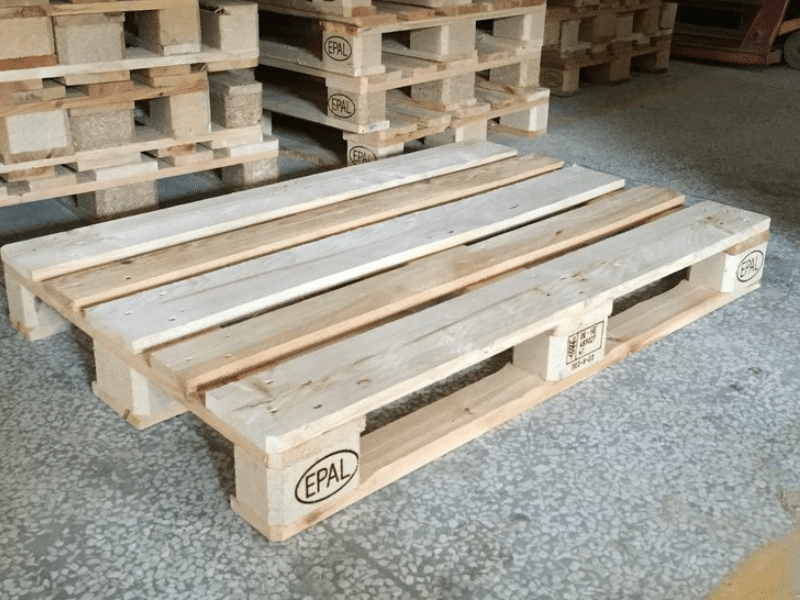
Besides the standard EUR 1 size of 1200 × 800 × 144 mm, European pallets also include EUR 2 pallets at 1200 × 1000 mm, half pallets at 800 × 600 mm, quarter Euro pallets, and other sizes. The height of wooden Euro pallets is not fixed. It is usually affected by pallet structure, fork entry space, load capacity, packaging type, and industry application. The table below gives you a detailed look at common Euro pallet dimensions.
| Pallet Type | Dimensions | Material | Approx. Weight | Practical Use |
| EUR 1 / EPAL 1 Euro Pallet | 1200 × 800 × 144 mm | Wood | 25 kg | Standard European exchange pallet |
| EPAL Euro Pallet QR | 1200 × 800 × 144 mm | Wood | 25 kg | EPAL pallet with QR traceability |
| EUR 2 / EPAL 2 Industrial Pallet | 1200 × 1000 × 162 mm | Wood | 35 kg | Wider industrial loads |
| EUR 3 / EPAL 3 Pallet | 1000 × 1200 × 144 mm | Wood | 30 kg | International and Asian logistics links |
| EPAL 6 Half Pallet | 800 × 600 × 144 mm | Wood | 9.5 kg | Display, retail, small loads |
| EPAL 7 Half Pallet | 800 × 600 × 163 mm | Wood + steel brackets + plastic block | 9.5 kg | Retail display and half-pallet handling |
| EPAL CP1 Pallet | 1000 × 1200 × 138 mm | Wood | Varies | Chemical and industrial packaging |
| EPAL CP2 Pallet | 800 × 1200 × 138 mm | Wood | Varies | CP logistics and industrial goods |
| EPAL CP3 Pallet | 1140 × 1140 × 138 mm | Wood | Varies | Drums, octabins, bulk packaging |
| EPAL CP4 Pallet | 1100 × 1300 × 138 mm | Wood | Varies | Bagged goods and chemical products |
| EPAL CP5 Pallet | 760 × 1140 × 138 mm | Wood | Varies | Narrow industrial loads |
| EPAL CP6 Pallet | 1200 × 1000 × 156 mm | Wood | Varies | Industrial and chemical logistics |
| EPAL CP7 Pallet | 1300 × 1100 × 156 mm | Wood | Varies | Large industrial loads |
| EPAL CP8 Pallet | 1140 × 1140 × 156 mm | Wood | Varies | Heavy drums and container loads |
| EPAL CP9 Pallet | 1140 × 1140 × 156 mm | Wood | Varies | Chemical and drum logistics |
These wooden Euro pallet dimensions are useful for reference, but if your project needs cleaner handling, repeated reuse, export convenience, or custom structure, the plastic Euro pallet section below will be more relevant to your decision.
Euro Plastic Pallet Dimensions
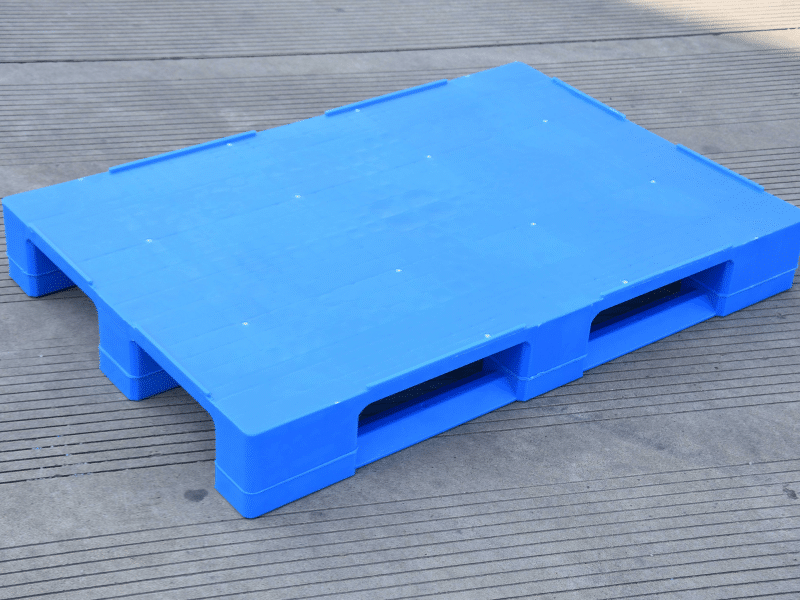
The most common size for a Euro plastic pallet is also 1200 × 800 mm, which is one of the pallet dimensions covered by the ISO 6780 standard. Euro plastic pallets also include half pallet sizes such as 800 × 600 mm, quarter pallets such as 600 × 400 mm, and other Euro-format plastic pallet options.
| Pallet Type | Dimensions | Material | Notes |
| EURO H1 Plastic Pallet | 1200 × 800 × 160 mm | HDPE / PE | Common hygienic plastic Euro pallet for food and meat logistics |
| H2 Plastic Half Pallet | 800 × 600 × 160 mm | HDPE / PE | Half-size hygienic pallet for Euro boxes, retail, and small loads |
| H3 Plastic Pallet | 1200 × 1000 × 160 mm | HDPE / PE | Industrial-size hygienic pallet for heavier food and logistics use |
| Quarter Euro Pallet | 600 × 400 mm | HDPE / PE / PP | Retail display, point-of-sale goods, small-load handling |
Euro Pallet vs. EPAL Pallet
An EPAL pallet is one of the most widely used exchange pallets in the world. It is mainly used in Europe, but this does not mean it must be produced in Europe. A Euro pallet is a broader term. In daily use, many people call the EPAL 1 pallet a Euro pallet because it uses the classic 1200 × 800 mm European pallet size.
The key difference is simple: EPAL pallet refers to a pallet made under EPAL rules, with official markings and exchange standards. Euro pallet can refer more generally to a pallet with European dimensions, especially the 1200 × 800 mm size.
Euro Pallet vs. UK Pallet
A Euro pallet is usually 1200 × 800 mm. A standard UK pallet is usually 1200 × 1000 mm. The two sizes share the same 1200 mm length, but the UK pallet is 200 mm wider.
| Pallet Type | Common Size | Main Difference |
| Euro Pallet | 1200 × 800 mm | Narrower, common in Europe |
| UK Pallet | 1200 × 1000 mm | Wider, common in UK distribution |
Let’s break it down a little more:
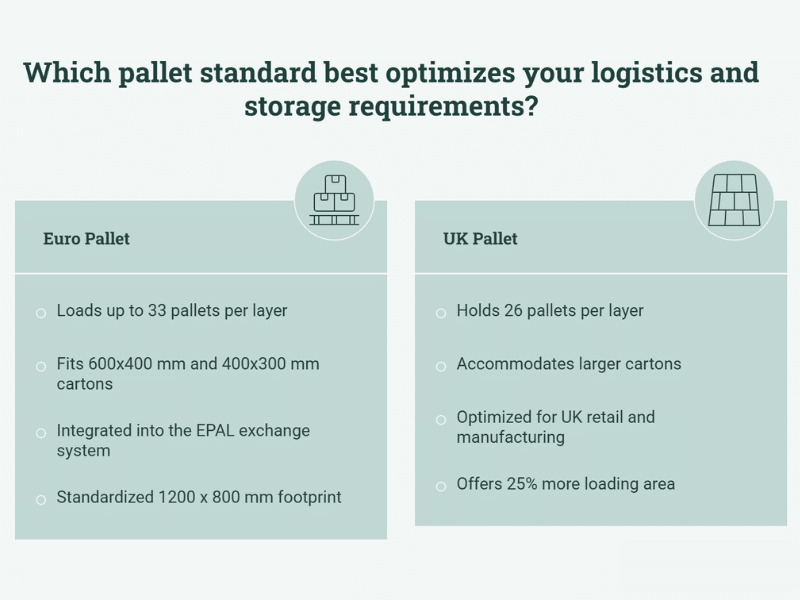
The 1200 × 800 mm Euro pallet fits very well with local European warehouse racking, forklifts, automated conveyor lines, and daily logistics handling. A standard European truck can load up to 33 Euro pallets per layer, which makes better use of the truck width of around 2.45 m. In retail distribution, Euro pallets also work well with European goods packed in 600 × 400 mm and 400 × 300 mm cartons or crates. They can also move through the EPAL pallet exchange system, which has more than 650 million EPAL pallets in circulation.
The wider UK pallet is better for larger cartons used in the UK market, and it is widely used in retail warehousing and manufacturing distribution. For truck loading, a standard UK trailer is usually around 13.6 m long. With a loading pattern of 13 rows × 2 pallets per row, it can hold 26 UK pallets per layer. This is about 7 pallets fewer than a Euro pallet load, but each UK pallet has 25% more loading area than a Euro pallet.
So in a full-truck comparison, 33 Euro pallets in a European trailer and 26 UK pallets in a UK trailer provide almost the same total pallet loading area. The UK pallet count is lower, but the truck space is still used well.
For more details, you can also read our guide to UK pallet dimensions.
Euro Pallet vs. US Pallet
The main difference is that a Euro pallet is clearly smaller in both length and width than a U.S. GMA pallet.
A U.S. pallet, also called a GMA pallet, measures 48 × 40 inches, or about 1219 × 1016 mm. This pallet size fits larger U.S. cartons, retail distribution, and 53 ft trailer transport, where one layer can usually hold 26–30 pallets.
| Pallet Type | Common Size | Main Market |
| Euro Pallet | 1200 × 800 mm | Europe |
| US GMA Pallet | 1219 × 1016 mm / 48 × 40 in | North America |
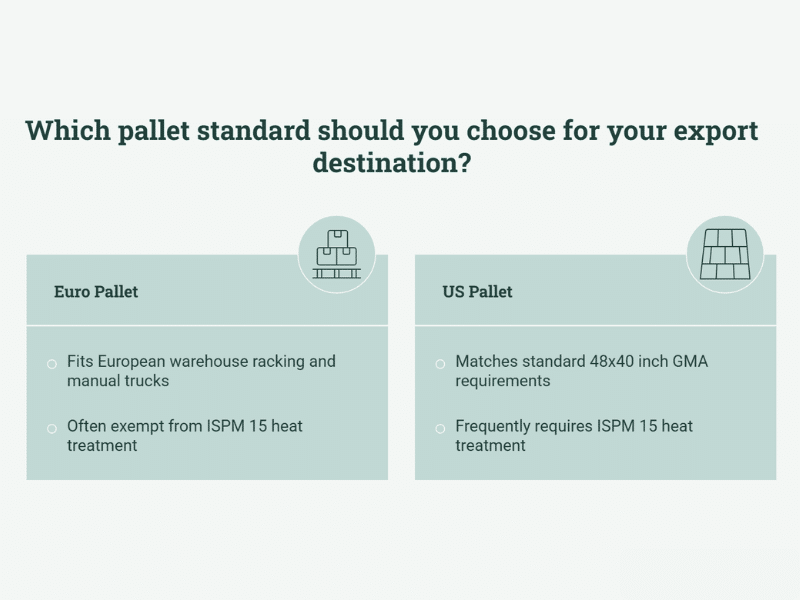
If your goods are exported to Europe, and your customer’s warehouse, trucks, and racking system are all built around European standards, you should choose Euro pallet dimensions. Do not try to use a U.S. pallet in this case, because the bottom deck boards of a U.S. pallet are often hard to match with European manual pallet trucks, and the wider pallet size may not fit well in European racking systems.
If your goods are exported to the United States, please confirm whether your receiver needs a 48 × 40 inch pallet. The 48 × 40 inch GMA pallet is the most common size in the U.S., but not every industry uses this pallet size.
If you need pallets for export shipping, our nestable plastic Euro pallets are usually not subject to ISPM 15 heat treatment or fumigation requirements. Later in this article, we will compare the advantages and limits of wooden Euro pallets and plastic Euro pallets more clearly.
What Is the Difference Between a Wood Euro Pallet and a Plastic Euro Pallet?
A wood Euro pallet and a plastic Euro pallet are not only different in material. The real difference is how they are used, how they move in the supply chain, and whether the pallet needs to enter an open exchange system or stay inside your own circulation.
One practical difference is the height. A standard wood Euro pallet is usually 144 mm high, mainly because the EPAL/EUR pallet system has fixed requirements for its size and structure. A Euro plastic pallet can be controlled at around 150–160 mm, so it can better match European automation systems, pallet jacks, containers, forklifts, racking systems, and conveyor lines.
To make the choice easier, you can look at five practical differences: exchange system, hygiene area, racking and automation, circulation model, and long-term cost.
1. Wood works well in open pallet exchange.
A standard wood Euro pallet uses a nine-block, four-way entry structure. It is different from a plastic nine-leg pallet. The core structure of a standard EPAL Euro pallet is 11 wooden boards, 9 wooden blocks, and 78 nails. A qualified wood Euro pallet can enter the European pallet exchange system, where pallets can be exchanged on a “pallet for pallet” basis. This is why wood Euro pallets are widely used for general transport, dry goods distribution, retail logistics, and pallet exchange systems.
2. Plastic works better in cleaner areas.
When pallets enter open food handling areas, washdown zones, clean rooms, or controlled production areas, wood can bring splinters, moisture absorption, mold, wood chips, dust, and cleaning problems. For food processing, meat handling, dairy, pharmaceuticals, medical products, and cold chain logistics, H1 hygienic plastic pallets or other Euro-size plastic pallets are often used.
3. Plastic gives more structure choices for racking and automation.
Euro plastic pallets have more structure options than wood Euro pallets. Common types include nestable Euro pallets for local return logistics or one-way shipping, 3-runner Euro pallets for European racking systems, double-sided Euro pallets for heavy stacking or automated production lines, full perimeter Euro pallets for heavy-duty handling, and 9-leg Euro pallets for warehousing and floor stacking. Plastic pallets also have a rough surface, and welded anti-slip pads can be added, so the grip performance can match or even beat a wood Euro pallet.
4. The circulation model is different.
Wood Euro pallets are strong in the European open exchange system. Plastic pallets do not yet have one unified management system like EPAL. But Euro plastic pallets are very suitable for closed pool systems, such as your own factory circulation, group-level pallet reuse, or fixed rental and recovery programs with long-term partners.
5. Plastic brings better long-term value in repeated use.
A European wood pallet usually lasts 3–10 years, depending on use, repair, humidity, and handling damage. A Euro plastic pallet usually lasts 7–10 years, so it has a longer service life in repeated use. It can also reduce replacement cost, cleaning trouble, pallet damage, mold risk, loose nails, and wood chip problems over time.
Why Plastic Euro Pallets Can Reduce Long-Term Cost
A wooden Euro pallet usually costs around $25 at the first purchase. But during repeated use, wood pallets may break, absorb moisture, grow mold, lose nails, drop wood chips, and become difficult to clean. If you use them for export, they may also need ISPM 15 heat treatment or fumigation. These extra steps can bring hidden costs and may also delay shipment.
A plastic Euro pallet may cost 1–3 times more than a wooden Euro pallet at the beginning, but it usually brings better value over long-term use. It has no nails, uses a one-piece molded structure, and can be washed and reused many times. This makes it a better choice for food, cold chain, pharmaceutical, and closed-loop logistics.
When you need pallets to stay stable in racking, run smoothly on conveyor lines, support custom colors, carry printed logos, or look cleaner in retail display, a plastic Euro pallet is also more suitable than a wooden Euro pallet.
For export, plastic pallets usually do not need ISPM 15 heat treatment or fumigation, because ISPM 15 applies to wood packaging materials. This makes plastic Euro pallets easier to use in international shipping.
If you want to compare purchase price and long-term use cost in more detail, you can read our guide: how much do pallets cost.
What Regulations Should You Consider When Purchasing Euro Pallets?
Before you order Euro pallets, check these points:
1. Export rules
Wood pallets need ISPM 15 treatment and marking for many international shipments. Plastic pallets normally avoid this issue because they are not wood packaging material.
2. Food contact and hygiene requirements
For food, meat, dairy, pharmaceutical, or medical use, ask for material information, cleaning suitability, and any required test reports.
3. Load definition
Static load, dynamic load, and racking load are different. A pallet with a 5,000 kg static load may not be safe in racking unless it has been designed and tested for racking.
4. Warehouse equipment compatibility
Confirm pallet jack use, forklift fork opening, conveyor roller gap, AS/RS tolerance, rack beam span, and pallet deflection limits.
5. Material and temperature
HDPE is often preferred for impact resistance and cold environments. PP can be used for certain warehouse and logistics conditions. UV, anti-static, flame-retardant, or low-temperature additives can be added when needed.
6. Customer acceptance
If your customer needs EPAL exchange pallets, a normal plastic Euro pallet may not replace that exchange function. If your customer needs size compatibility, hygiene, or long reuse, plastic is often the stronger option.
At Enlightening Pallet, we supply plastic Euro pallets from China for export, warehousing, racking, food logistics, retail distribution, and factory circulation. We can help you choose the right Euro pallet dimensions, structure, material, color, logo, and load level for your actual working conditions.
FAQ
1. What Is the Weight of a Euro Pallet?
A standard wooden EUR 1 / EPAL 1 pallet weighs about 25 kg, while a plastic Euro pallet can range from around 10 kg to more than 25 kg depending on structure and load capacity. A common EURO H1 plastic pallet is often around 18 kg.
2. What Are Euro Pallets Used For?
Wooden Euro pallets are widely used for general transport, retail distribution, dry goods, and pallet exchange. Plastic Euro pallets are better for hygiene areas, food processing, cold chain, export shipping, automation, and long-term warehouse reuse.
3. What Is the Load Capacity of a Euro Pallet?
A wooden EPAL 1 pallet has a safe working load of 1,500 kg and a maximum stacked load of 5,500 kg on a solid, even surface. Plastic Euro pallet capacity depends on the model, but heavy-duty designs can support high static, dynamic, and racking loads.
4. What Materials Are Used for Euro Plastic Pallets?
Euro plastic pallets are commonly made from HDPE or PP. You can choose virgin material, recycled material, or modified material with UV resistance, anti-static properties, cold resistance, or flame retardance.
5. Can Euro Plastic Pallets Be Used in Racking?
Yes, but only if the pallet is designed as a rackable plastic pallet. For racking, you should confirm rack span, cargo weight, steel reinforcement needs, deflection limits, and test data before ordering.
6. Do Euro Plastic Pallets Need ISPM 15 or Fumigation?
No, plastic Euro pallets normally do not need ISPM 15 heat treatment or fumigation. ISPM 15 applies to wood packaging material, not plastic pallets.
7. How Many Euro Pallets Fit in a Truck or Container?
A standard European trailer usually fits 33 Euro pallets in one layer. A 20ft container often fits around 11 Euro pallets, and a 40ft container often fits around 23–24 Euro pallets, depending on loading pattern, pallet height, cargo overhang, and stacking method.
Final Thought
Euro pallet dimensions are simple at first glance: 1200 × 800 mm. But the right pallet choice depends on much more than length and width.
If you only need a low-cost exchange pallet, a wooden Euro pallet may work. If you need cleaner handling, longer reuse, export convenience, stable dimensions, custom branding, or better performance in racking and automation, a plastic Euro pallet is often the smarter choice.
Tell us your load weight, pallet size, warehouse system, and destination market. We will help you choose a plastic Euro pallet that fits your logistics instead of forcing your logistics to fit the wrong pallet.