跳到内容
跳到内容 
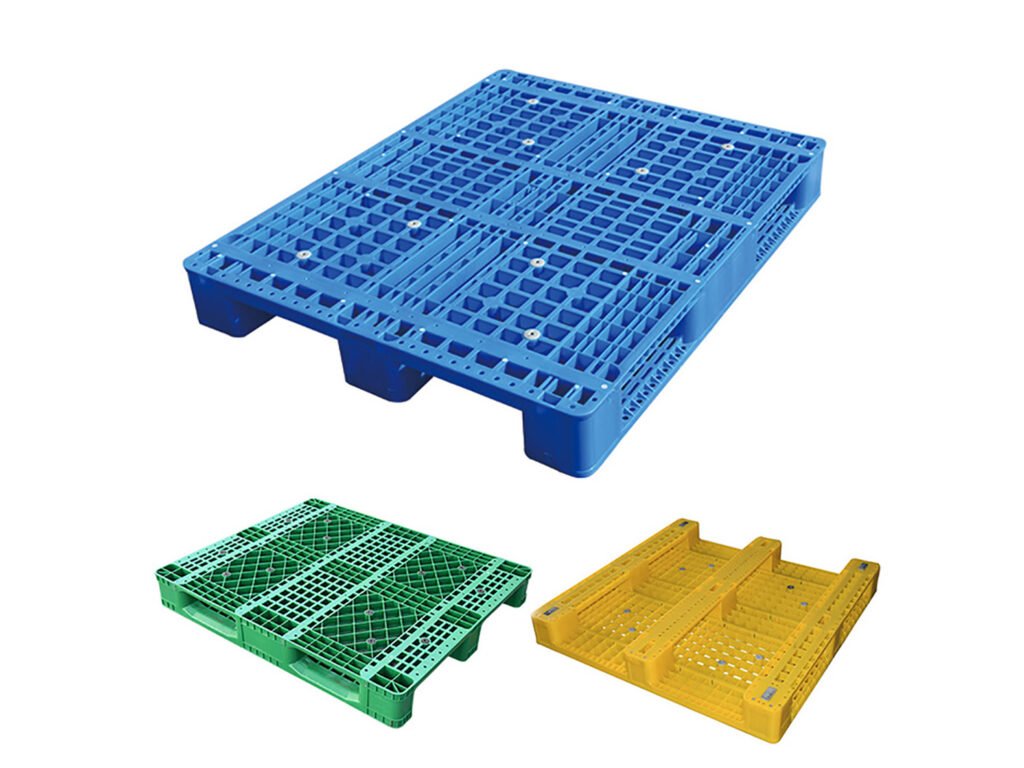
Plastic pallets have become the backbone of modern logistics and warehousing operations. But here’s what many don’t realize: the manufacturing process you choose directly determines your pallet’s load capacity, durability, and overall performance.
Currently, three mainstream manufacturing processes dominate the industry – injection molding, blow molding, and rotational molding. Each serves distinct strength requirements and application scenarios. So which process is right for your specific needs? Let’s break down these three manufacturing technologies and help you make an informed decision.
Injection Molding Process
Injection molding manufacturing is the most mainstream production process for plastic pallets today:
• High Efficiency: Short cycle times enable daily production of thousands of pallets per machine
• Design Flexibility: Creates complex structures like reinforcements, anti-slip patterns, and stacking grooves
• Material Efficiency: Virtually waste-free process with recyclable runners and sprues
• Precision & Consistency: Ensures dimensional stability for standardized logistics equipment compatibility
• Cost-Effective: Low per-unit costs despite high initial mold investment
Here’s how it works: first, plastic granules are melted into a viscous flow, then injected under high pressure into precision molds, and finally cooled to form the final product.
Injection-molded plastic pallets offer smoother surfaces compared to other manufacturing processes, along with precise dimensions and excellent structural integrity – making them perfect for various industries and load requirements.
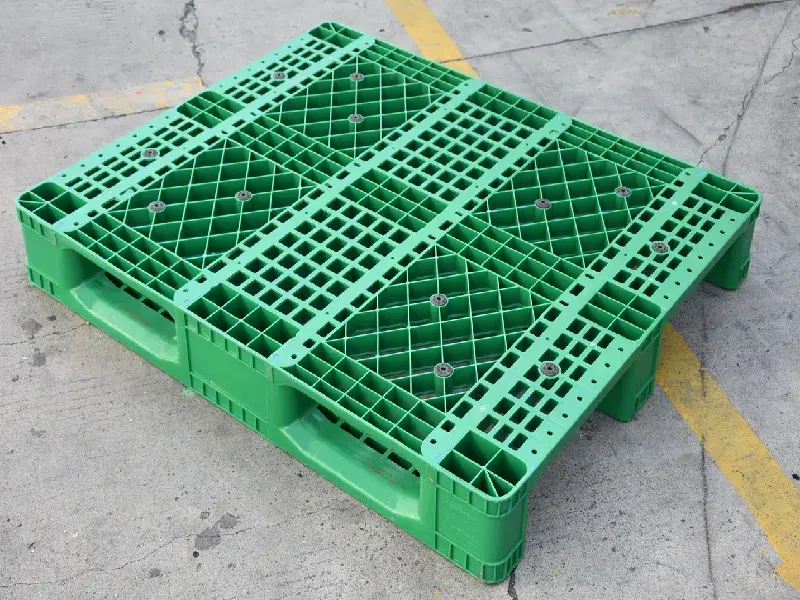
But what exactly happens during this complex manufacturing process? Let’s explore the injection molding production process of a plastic pallet.
Detailed Production Process of Injection Molding
Raw Material Preparation
Plastic granules (such as PP or HDPE) must be pre-dried to prevent moisture from causing bubbles or surface defects. The material enters the injection molding machine’s barrel through a hopper – think of this as the starting point where quality control begins.
Melting and Plasticizing
The barrel’s rotating screw heats plastic granules to 180-300°C (depending on material type), transforming them into a homogeneous viscous flow. This temperature precision is crucial – too hot damages the material, too cool creates incomplete melting.
Injection Molding
Here’s where the magic happens: molten plastic gets injected under high pressure (50-200 MPa) through a nozzle into closed mold cavities. The mold design includes gates and runners that guide the plastic flow – poor design here leads to weak spots in your final pallet.
Pressurizing and Cooling
- Pressurizing stage: Pressure maintains for a short period to compensate for material shrinkage, ensuring dense products without unsightly shrinkage marks
- Cooling phase: Water or oil circulation cools the mold to solidify the plastic (timing varies from seconds to minutes based on product thickness)
Mold Opening and Ejection
The mold opens and ejector mechanisms push the formed pallet from the cavity. Post-processing may include trimming sprues and burrs to achieve that professional finish you expect.
Blow Molding Process
Blow molding, also known as hollow molding, uses specialized blow molding machines to create pallets through air pressure expansion. Unlike injection molding where molten plastic fills a solid mold cavity, blow molding works by inflating a heated plastic tube (parison) inside a mold – think of it like blowing up a balloon inside a box to take its shape.
The key difference? While injection molding offers higher precision, blow molding excels in creating hollow structures with good dimensional consistency suitable for most logistics applications.
Blow-molded pallets are commonly manufactured as double-layer hollow reversible pallets and nestable nine-feet pallets, offering versatile design options for different logistics needs.
Here’s a practical advantage: If your application requires heavier pallets for increased load capacity, blow molding naturally creates products with higher self-weight compared to injection-molded pallets. This extra weight translates directly into enhanced load-bearing strength – a win-win for demanding logistics environments.
So how does this fascinating process actually work? Let’s walk through each step:
Detailed Flow Description of Blow Molding Process
1. Plastic Melting and Parison Formation: High Density Polyethylene (HDPE) granules are fed into the extruder’s hopper and heated to approximately 200-250°C until molten. The extruder screw forces this molten plastic through a circular die head, forming a continuous hollow tube called a parison – this is the foundation of your future pallet.
2. Parison Cutting and Positioning: Once the parison reaches the predetermined length (typically matching the pallet’s height), it’s automatically cut by pneumatic knives and positioned precisely between the open mold halves.
3. Mold Closure and Clamping: The two-piece mold closes around the parison with high clamping force (often 100-500 tons), sealing the parison at both ends while leaving an air injection port at the top or bottom.
4. Air Injection and Expansion: Compressed air at 6-10 bar pressure is rapidly injected into the sealed parison through a blow pin. This forces the soft plastic to expand outward against the mold walls, taking the exact shape of the pallet cavity including all details like ribs, feet, and surface textures.
5. Cooling and Solidification: Chilled water or air circulates through cooling channels within the mold walls, rapidly reducing the plastic temperature from molten state to below 60°C. This cooling phase typically takes 30-90 seconds depending on pallet thickness and ensures dimensional stability.
6. Mold Opening and Part Ejection: Once cooled, the mold opens and ejector pins push the solidified pallet out. The pallet emerges as a complete hollow structure ready for final processing.
7. Trimming and Quality Control: Excess plastic flash around parting lines is trimmed using automated cutting tools. Each pallet undergoes dimensional inspection and load testing before packaging and shipment.
Rotational Molding Process
Rotational molding, also known as rotomolding or rotocasting, uses specialized rotational molding machines to create pallets through a unique heating and rotation process.
Unlike injection molding (high-pressure filling) or blow molding (air expansion), rotational molding works by loading plastic powder (primarily LLDPE/HDPE) into a mold, which rotates on dual axes (horizontal + vertical) inside a heating oven, allowing the powder to evenly coat and melt onto the mold’s inner walls before cooling into the final product.
So why choose rotomolding over other methods? The spinning action creates something remarkable – thicker, more uniform walls that give your pallets exceptional impact resistance. When you’re dealing with heavy loads or rough handling, this extra toughness makes all the difference.
But here’s what really sets rotomolding apart: Instead of forcing molten plastic under high pressure like injection molding, or inflating it with air like blow molding, rotomolding lets gravity and gentle centrifugal force do the work. This creates completely seamless products – no weak spots, no weld lines, no potential failure points.
And that’s exactly why you’ll find rotomolding at the heart of leak-proof pallet production. When manufacturers need pallets for hazardous chemicals, petrochemicals, or marine applications, they turn to rotomolding. Think about it – if you’re storing dangerous liquids or shipping goods across rough seas, you simply can’t afford a leak. The seamless, thick-walled construction from rotomolding gives you that bulletproof reliability for chemical storage, offshore platforms, port operations, and other demanding environments where standard pallets just won’t cut it.
Ready to see how this robust process creates your most demanding pallets? Let’s dive into the details:
Detailed Flow Description of Rotational Molding Process
1. Powder Loading and Mold Preparation: Pre-measured plastic powder (typically LLDPE or HDPE with particle sizes of 300-500 microns) is precisely loaded into the cleaned mold cavity. The powder quantity determines final wall thickness – usually 3-8mm for heavy-duty pallets.
2. Mold Sealing and Mounting: The multi-piece mold is securely bolted together and mounted on the dual-axis rotation arms of the rotomolding machine, ensuring perfect balance for smooth rotation.
3. Heating and Rotation Phase: The mold enters the heating oven (maintained at 200-300°C) while rotating at 4-20 RPM on both horizontal and vertical axes. This slow, continuous rotation ensures the melting powder coats every surface evenly – including complex geometries impossible with other processes.
4. Melting and Fusion: Over 10-40 minutes (depending on pallet size), the powder gradually melts and fuses into a homogeneous layer against the mold walls. The dual-axis rotation eliminates air bubbles and creates uniform wall thickness throughout.
5. Cooling Phase: The mold moves to the cooling station where forced air or water spray rapidly reduces temperature to below 60°C. This controlled cooling prevents warping and ensures dimensional accuracy.
6. Demolding and Inspection: Once cooled, the mold opens and the seamless pallet is carefully removed. Each piece undergoes thorough inspection for wall thickness, dimensional accuracy, and leak-proof integrity – crucial for containment applications.
7. Finishing Operations: Minor flash removal and quality testing (including leak testing for containment pallets) complete the process, delivering industrial-grade pallets ready for the most demanding applications.
Plastic Pallet Manufacturing Processes and Corresponding Pallet Types
Now that you understand the key differences and processes of the three major plastic pallet manufacturing technologies, as a manufacturer with 25 years in plastic pallet production, we’ve compiled our different process-based pallet types for you – these classifications also apply broadly across the entire pallet market.
| Process | Applicable Pallet Types | Key Features | Best Applications |
|---|---|---|---|
| Injection Molding | • 3 runner pallet • 6 runner pallet • Double sided pallet • 9 legs plastic pallet | High dimensional precision, excellent surface finish, ideal for standardized production and heavy-duty load requirements | Warehouse storage, automated systems, heavy industrial loads |
| Blow Molding | • Double sided pallet • 9 legs plastic pallet | Lightweight construction, cost-effective for medium loads, faster production cycles | Light to medium cargo transport, cost-sensitive applications |
| Rotational Molding | • Spill containment pallets | Thick seamless walls, superior chemical resistance, leak-proof integrity for hazardous material handling | Chemical storage, petrochemical facilities, marine transport, harsh outdoor environments |
Some pallet designs like double-sided pallets and 9-leg pallets can be produced using different processes – the choice often comes down to your specific load requirements, budget, and performance needs. Injection molding delivers precision and strength, blow molding offers cost efficiency, while rotational molding provides unmatched durability for specialized applications.
Summary
Through an in-depth analysis of injection molding, blow molding and rotational molding, we can better understand the technical core and application value of plastic pallet manufacturing. Injection molding has become the mainstream with its high efficiency and precision, while blow molding and rotational molding have their own strengths in specific fields. In the future, with the widespread application of environmentally friendly materials and intelligent technologies, plastic pallets will play a greater role in logistics and warehousing, while paying more attention to sustainability and efficiency.
If you’d like to dive deeper into our manufacturing expertise, check out our service page on manufacturing for more insights!