
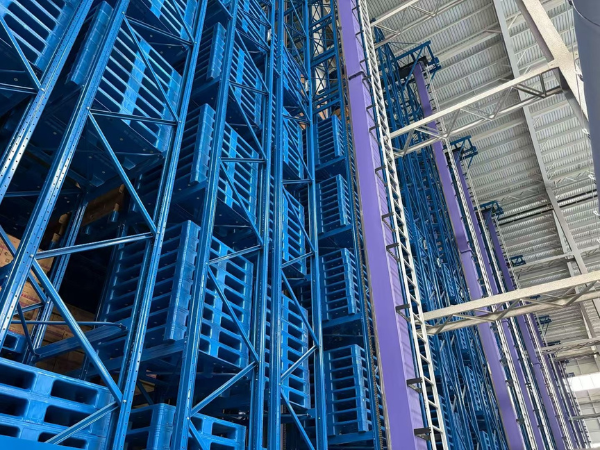
Your ASRS may not have a software problem. It may have a pallet problem. For an ASRS to run smoothly, the stacker crane, conveyors, sensors, and pallet must work together. If the pallet bends, breaks, sheds debris, or fails to meet dimensional accuracy standards, the whole ASRS line may stop.
Wooden pallets are more likely to create these risks. Wood boards and blocks are held together by nails or metal fasteners, and wood can absorb moisture and swell. Once the joints become loose or the pallet bends under heavy loads, your ASRS may face many errors. This article explains what problems wooden pallets can cause in ASRS, why plastic pallets are often the better choice, and how to check whether a plastic pallet is suitable for your system.
What ASRS Equipment Problems Can Wood Pallets Cause?
When pallets enter an ASRS, wood pallets are most likely to cause the following three failures.
- Wood pallet deformation causes pickup failure, error alarms, and ASRS shutdown
- Debris jams the rollers and stops the conveyor line
- Wood dust contaminates sensors and causes positioning alarms
These problems are costly because ASRS can only run according to fixed positions. It cannot observe the pallet and try again like a forklift driver. If the wooden pallets deformed or are damaged, the ASRS induction station, pallet centering device, stacker crane, telescopic fork, or photoelectric sensor may stop working.
If you still have a large number of wood pallets in your warehouse, you must check whether they can still enter your ASRS safely. We do not suggest judging only by appearance, even if the pallet may look complete on the floor. There are only 3 steps to check whether these pallets have deformed( these methods also apply to plastic pallets):
1. First, measure the pallet size.
You can choose a tape measure, vernier caliper, or square ruler, and prepare a marker.
Use these tools to check whether the pallet length, width, height, and fork opening height are still the same as the specifications when you first received this batch of pallets. Finally, check the diagonals, as shown below:
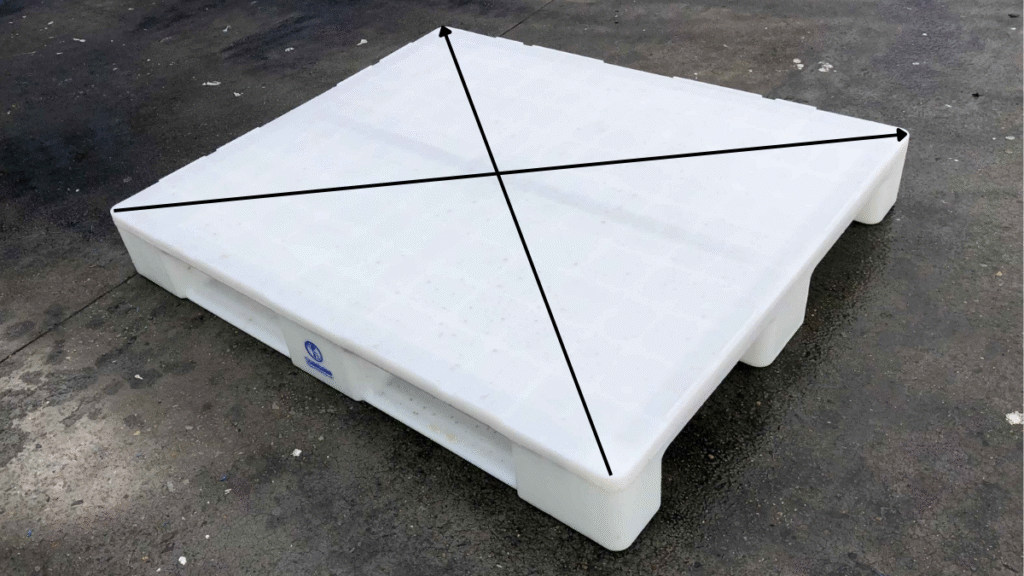
If the difference between the 2 diagonal measurements is more than 5 mm, it means the pallet already has slight deformation. This pallet may be rejected by the ASRS induction station. For double-sided pallets, we suggest measuring both the top and bottom sides, because one side may have a small difference while the other side may be larger.
2. Then check the center deflection of the pallet.
This step is to make sure your pallets can be used on high-bay racking on the ASRS. You can use:
- long straight ruler, aluminum profile, or a rope that can be fully tightened
- 2 bricks, wood blocks, or metal blocks with the same height
- The goods you normally stack on one pallet in your factory
1) First, place the two blocks under the left and right sides of the pallet. Do not place them randomly. Their position should match the rack beam span in your ASRS rack, and the center of the pallet should remain unsupported. In the image below, we used two I-beams to simulate the rack beams.
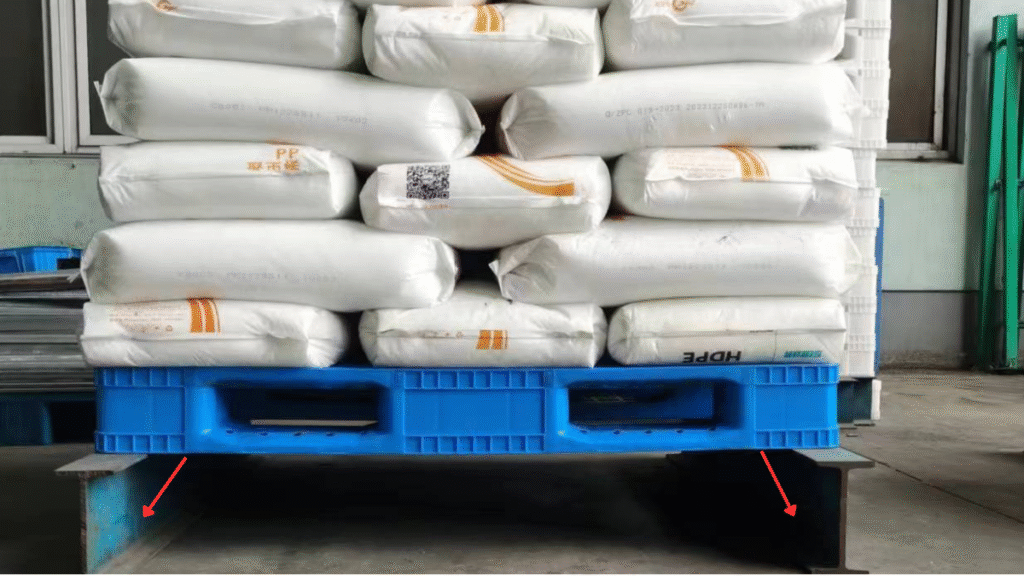
2) Then you can test the center deflection of the empty pallet. Place the prepared straight steel pipe on the relatively higher positions at both ends of the pallet, then measure the vertical gap from the steel pipe to the center surface of the pallet. For example, if the middle gap is 2 mm, it means the empty pallet has about 2 mm of center deflection.
3) Next, test the center deflection of the loaded pallet. Stack the heavy goods neatly in the same way as your daily stacking method, and leave them for 1–2 hours. Pull the rope tightly according to the highest points on the left and right ends of the pallet, then measure the sagging value from the rope to the pallet center.
If the empty pallet already has center sagging, you can use this formula:
Actual center deformation = loaded pallet sagging value − empty pallet sagging value
For example, if the empty pallet sagging is 2 mm and the loaded pallet sagging is 8 mm, the actual center deformation under load is 6 mm.
For pallet deflection, ISO 8611 states that the center deflection of a pallet supported on racks should usually not exceed 2% of the support span. ASTM D1185 requires it not to exceed 1.9%. Below is a table of the maximum deflection values for pallets with different support spans:
| Pallet Support Span | ISO 8611 Maximum Deflection 2% | ASTM D1185 Maximum Deflection 1.9% |
| 800 mm | 16 mm | 15.2 mm |
| 900 mm | 18 mm | 17.1 mm |
| 1000 mm | 20 mm | 19 mm |
| 1100 mm | 22 mm | 20.9 mm |
| 1200 mm | 24 mm | 22.8 mm |
However, in an ASRS system, the actual allowed deflection needs to be stricter because it also involves the induction station, conveyor line, sensors, stacker crane fork, and rack clearance. We suggest you follow the pallet tolerance requirements given by your ASRS system supplier.
3. Finally, check the pallet weight.
Wood absorbs moisture, and wet wood becomes heavier. Compare the current pallet weight with the weight data when you first received the pallets. If the pallet weight increases by more than 10%, this pallet may no longer match the load setting or rack load limit of your ASRS.
After you finish the above three tests, we suggest choosing 10 wood pallets with the worst test results and putting them into the ASRS for testing. Load these pallets with real goods and send them to your induction station. If these pallets cause induction failure, profile check failure, conveyor blockage, fork entry errors, or sensor alarms, it means most batches of wood pallets are no longer suitable for your ASRS.
You can continue using the rejected wood pallets in other scenarios, such as forklift handling, floor stacking, moisture-protected storage, or short-term turnover.
How Plastic Pallets Reduce Downtime in ASRS?
Plastic pallets can help reduce downtime in your ASRS for the following reasons:
1. Plastic pallets have more accurate dimensions.
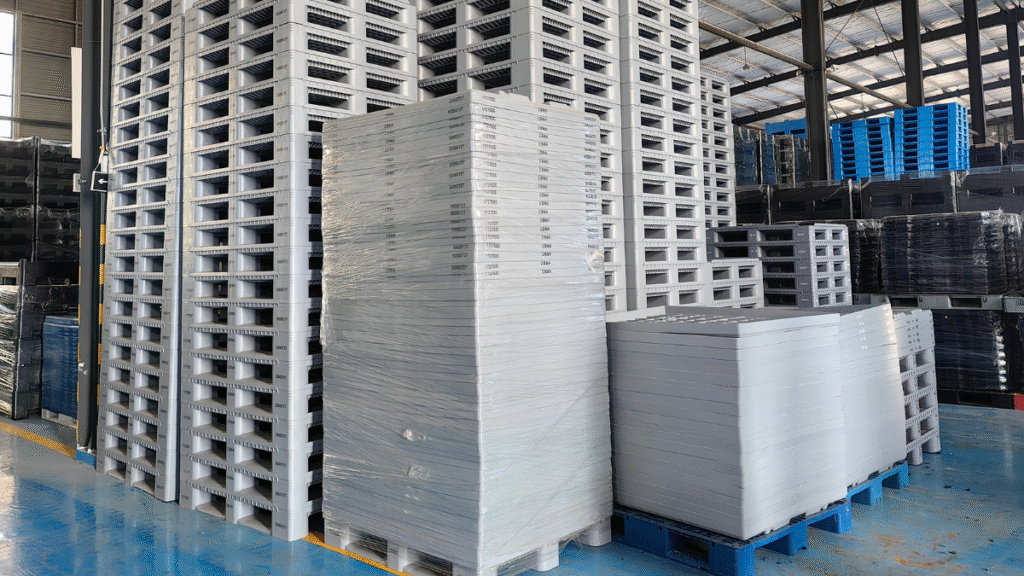
Automation equipment such as induction stations, pallet centering devices, barcode scanners, RFID readers, and stacker cranes all depend on stable pallet dimensions. Plastic pallets are mass-produced by injection molding or blow molding, so the tolerance of each batch is more stable. You do not have to deal with the same size variation that often happens with wood pallets. Virgin plastic pallets can also keep a stable structure after hundreds of repeated cycles.
2. Plastic pallets have lower rack-load deflection.
Pallet center deflection directly affects the long-term storage stability of a loaded pallet on racking. If pallet deflection is not well controlled, the following problems may happen:
| Problem | What May Happen |
| Goods may tilt or collapse | A pallet with serious center sagging can shift the center of gravity of the goods. When the stacker crane stores or retrieves the pallet, the goods are more likely to collapse. |
| ASRS positioning errors may happen | After the pallet center sags, the pallet may move away from the original fork entry position set by the stacker crane. This may increase the risk of the stacker crane hitting the rack beam during retrieval. |
| Extra stress may be added to the racking | After the pallet sags, the load may change from being evenly supported by the whole pallet to being supported mainly by the two side edges. This can concentrate the load on a local area of the rack, create a Warehouse Racking Safety risk, and over time, the racking may deform or even collapse. |
Like wood pallets, plastic pallets can also creep. But after short-term loading, plastic pallets can usually recover most of their shape. Under long-term loading, built-in or external steel tubes can further slow down the creep speed of the pallet. Wood pallets can only improve performance through post-processing, but the natural properties of wood cannot be directly changed. Plastic pallets can be customized from the material formula, such as adding glass fiber reinforcement for ASRS racking use, which can slow down pallet sagging more effectively than wood pallets.
If you are still not sure how a rackable pallet works on warehouse racking, you can also read our article What Is a Rackable Plastic Pallet for a clearer explanation.
3. Plastic pallets do not shed chips or loose nails.
Plastic pallets are made by one-piece injection molding. Even under friction, they usually only have surface wear and do not shed chips like wood pallets. This can reduce the risk of roller conveyor blockage or chain conveyor damage, and it can also reduce the need for manual cleaning.
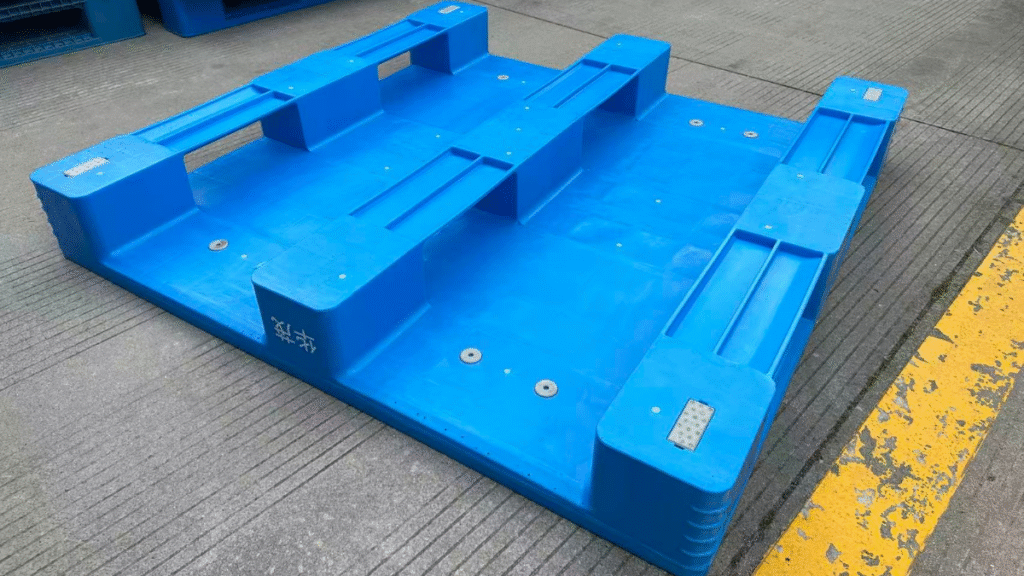
4. Plastic pallets are better suited for humid and low-temperature environments.
Plastic does not swell with water like wood pallets, so moisture will not affect the pallet weight in the same way. This can reduce reject alarms from the ASRS weighing station. In addition, HDPE plastic pallets can remain stable above -70°C and is less likely to become brittle or crack, so you can reduce the replacement frequency of cold storage pallets.
5. Plastic pallets can support RFID, barcodes, and automated tracking.
Wood pallets usually use adhesive labels, and once they get wet, the labels may fall off. Plastic pallets can reserve an RFID tag slot at the bottom for you, making the tag less likely to fall off. If you already rely on RFID to track pallets, you will find that your system can identify pallets faster and more safely.
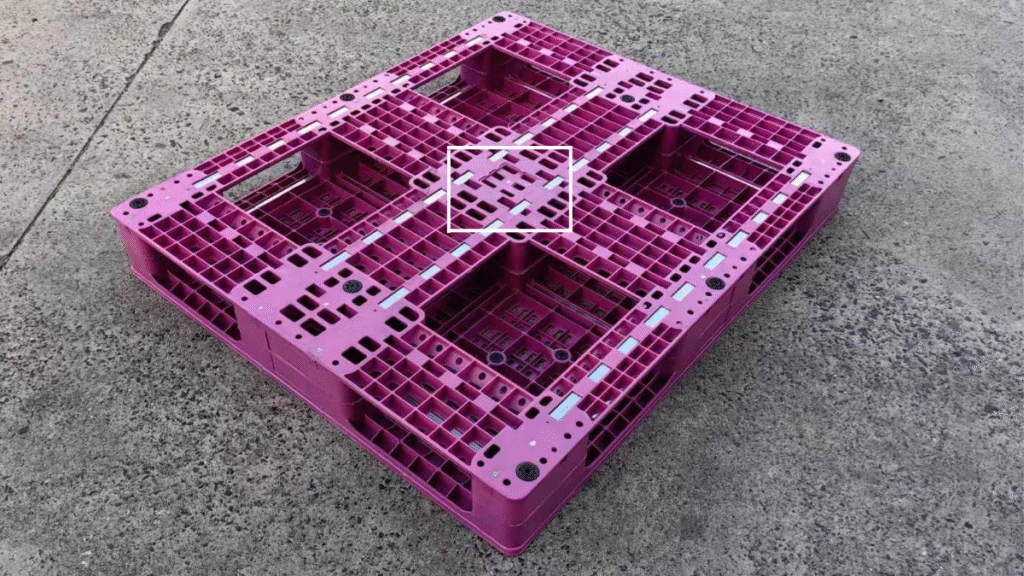
6. Plastic pallets are more hygienic.
Plastic pallets are easier to clean and dry, and they do not mold or attract pests like wood pallets. This helps keep the conveyor line cleaner and reduces your losses caused by jams, false alarms, and downtime.
What Makes a Plastic Pallet ASRS-Ready?
Not every plastic pallet is ready for ASRS. A standard warehouse plastic pallet may work for forklift handling. But it may still fail in an ASRS Automated Storage Retrieval System if the structure, bottom design, fork opening, or deflection control does not match the equipment.
We suggest you check these points before you approve a plastic pallet for ASRS.
| ASRS-Ready Requirement | What It Means for You |
| Tight dimensional tolerance | Choose virgin plastic pallets that can clearly control dimensional tolerance around ±2 mm. Ask the supplier to confirm the tolerance range before ordering. |
| Stable diagonal tolerance | Choose one-piece injection molded plastic pallets without welding. This structure helps keep the diagonal lines more stable and reduces the risk of pallet skew. |
| Strong structure | Choose plastic pallets with more internal reinforcement ribs. A stronger rib structure helps the pallet resist twisting, cracking, and repeated handling damage. |
| Stable fork opening | Choose plastic pallets with 4-way fork entry. This makes the pallet easier to handle by forklifts, stacker crane forks, shuttle forks, or telescopic forks. |
| Low deflection | Choose pallets with a rack load test report. Ask the manufacturer to provide pallets with built-in reinforcement ribs to reduce center sagging under full load. |
| Stable rack beam contact | Choose 3-runner or 6-runner plastic pallets for high-bay racking use. These bottom structures provide more stable contact with rack beams. |
| Consistent weight | Choose plastic pallets with a lighter tare weight but stronger load capacity. This helps reduce handling weight while keeping stable performance in ASRS. |
| No loose parts | Choose connector-free plastic pallets. Pallets without nails, screws, or loose parts can reduce foreign object risks in conveyor lines and ASRS equipment. |
| Flat bottom structure | For conveyor-based ASRS, choose a 6-runner bottom structure. Do not choose 9-leg pallets if your system depends on smooth roller or chain conveyor movement. |
| Sensor-friendly surface | The pallet shape and surface should be smooth and stable. This helps photoeye sensors and pallet detectors read the pallet position more accurately. |
| RFID-ready design | The pallet side should have a fixed barcode area, and the bottom can reserve a protected RFID tag position. This helps your ASRS identify and track pallets more reliably. |
To handle seasonal demand increases, you should also consider using plastic pallets made without recycled material, even if the product page says the recycled pallet can support a 6T static load. Recycled plastic pallets may only last for a limited number of cycles, while virgin plastic pallets usually offer much longer service life and more stable performance in ASRS. If you want to compare different material choices more clearly, you can also read our article Plastic Pallet Lifespan.
When choosing ASRS pallets, you should pay more attention to the rack load than the static load. In most ASRS racking applications, a rack load of 1.5–2T can meet the needs of most goods.
When Do You Need Steel Reinforced Plastic Pallets for ASRS?
Steel reinforcement helps the pallet resist bending force and reduces center sagging when the loaded pallet sits on rack beams. Not every warehouse needs steel reinforced plastic pallets. If your project has the following conditions, you should seriously consider using steel reinforced plastic pallets:
- Your loaded pallet weight is over 1000 kg.
- Your rack beam span is over 800 mm.
- There is a long unsupported distance between the pallet and the rack beams.
- The pallet needs to stay on the rack for a long time.
- Your ASRS runs at high frequency every day.
- You have very strict requirements for pallet deflection.
- Your stacker crane has strict requirements for fork entry into the pallet openings.
- You may already have rack stop alarms or retrieval failures.
- Your current wood pallets or standard plastic pallets sag under load.
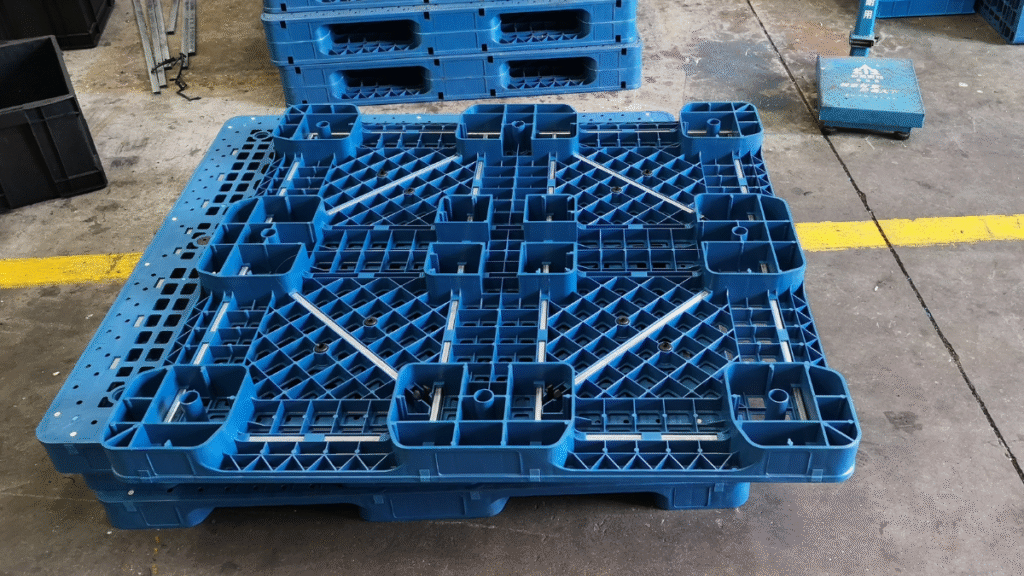
If your load is heavy, your rack span is long, and your ASRS works at high speed, steel reinforced plastic pallets are usually the safer choice. If you are not sure how to match pallet size with rack beam span, you can also read our Pallet Racking Sizes Guide before choosing the pallet structure.
Are Plastic Pallets More Expensive Than ASRS Downtime?
Plastic pallets cost more than wood pallets at the first purchase. That is true.
But we suggest you to compare the pallet price with the downtime cost.
Let‘s use this simple formula:
Single Downtime Loss = Downtime Hours × Production Loss per Hour + Labor Intervention Cost + Equipment Repair Cost
Let’s take a medium-sized beverage warehouse as an example.
| Cost Item | Example Estimate |
| 1 hour downtime, about 200 pallets not moved in or out | ¥6,000–10,000 |
| Manual intervention, 2 workers × 2 hours | ¥300–500 |
| Conveyor roller or sensor repair | ¥2,000–8,000 |
| Estimated loss from one downtime event | ¥8,000–18,000 |
If wooden pallets cause 2 to 4 downtime incidents per month in the ASRS warehouse, the monthly downtime loss = ¥8,000 × 3 incidents = ¥24,000 per month.
Now compare pallet cost.
| Cost Item | Wood Pallet | Plastic Pallet |
| Unit price | ¥80–150 | ¥200–400 |
| Typical service life | 6–12 months | 5–10 years |
| 5-year purchase cost for 1000 pcs, if wood pallets are replaced once per year | ¥400,000–750,000 | ¥200,000–400,000 |
| 5-year downtime loss from 3 events per month at ¥8,000 each | ¥1,440,000+ | Much lower after correct pallet matching and testing |
| 5-year combined cost | ¥1,840,000+ | Around ¥200,000–400,000 plus normal maintenance |
Overall, the five-year cost of wood pallets includes pallet purchase cost, downtime loss, repair cost, cleaning cost, and manual handling cost. The five-year cost of plastic pallets mainly includes pallet purchase cost and normal inspection cost. If wood pallets need to be replaced every six months, their total purchase cost will also become higher.
Future Trends for Plastic Pallets in ASRS Automated Storage Retrieval System
ASRS will keep moving toward faster storage speed, higher storage density, better tracking, and smarter warehouse control. A modern ASRS usually forms part of broader Intelligent Logistics that integrate conveyors, AGVs, AMRs, warehouse control systems, and automated identification equipment. Plastic pallets will not only be used to move goods, but will also support cleaner tracking, safer automation, and more stable closed-loop use.
When you purchase new ASRS pallets again, we suggest choosing plastic pallets with RFID-ready design, high rack load, tight tolerance, and steel reinforcement. You can contact Enlighten Pallet to get ASRS samples for your future pallet needs. Many of our customers also prepare extra pallets in advance for peak-season turnover.
Final Thought
Overall, plastic pallets are more suitable for automated warehouses in terms of dimensional stability, cleaning and maintenance, RFID tracking, low-temperature use, and long-term repeated cycles. They can help you reduce pallet-related downtime, lower the risk of equipment damage, reduce manual cleaning, and keep your warehouse running steadily during high-frequency turnover and peak-season shipments.
If you are choosing plastic pallets for ASRS project, or replacing your current wood pallets and standard plastic pallets, you can send us the pallet size you need. To recommend suitable plastic pallet solutions, we will also review your goods’ weight, rack beam span, fork thickness, conveyor type, storage temperature, allowed deflection, and customization requirements, then provide several options for your project. Welcome to call us directly or fill out any forms on this page!