跳到内容
跳到内容 
When you use pallets on warehouse racking, the load limit is never just about the rack itself. It also depends on how your pallet transfers weight to the beams, how your goods sit on the pallet, and how that load behaves over time.
Most rack failures, pallet deformations, and capacity miscalculations trace back to one overlooked variable: the pallet was never engineered to match the racking system it was placed on.
That is why pallet rack load capacity is not a number you should read in isolation. In this guide, you will learn what racking load capacity actually measures, how plastic pallet structure directly affects whether you achieve it, and what to verify before you commit to a pallet specification.
What Is Pallet Rack Load Capacity?
Pallet rack load capacity is the maximum weight a rack system can safely hold when a loaded pallet sits on the beams.
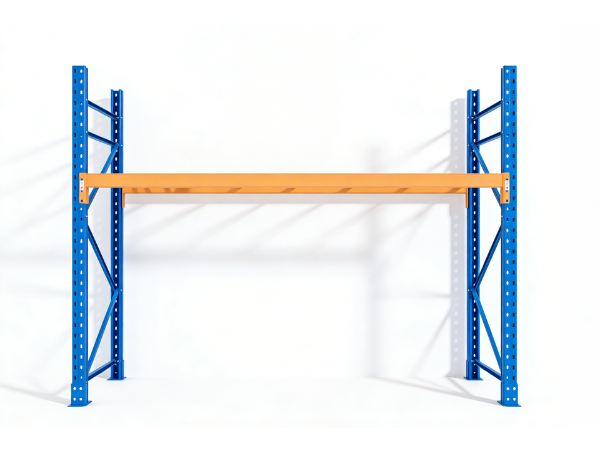
To see why pallet rack load capacity matters, follow where the load goes. The load starts with your goods, moves into the pallet deck, passes through the runners, and ends where the pallet sits on the rack beams. Pallet rack load capacity is worked out from both beam capacity and upright frame capacity. In other words, the load has to be supported not only by the beams, but by the whole rack structure. This is also where a mismatch between pallet design and rack setup can start to cause problems.
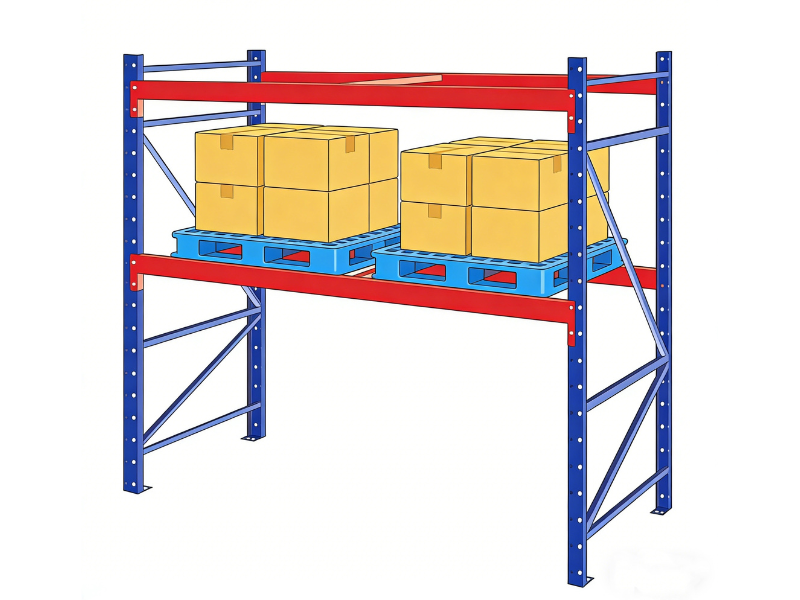
Pallet rack load capacity is also not just one number. It includes 3 separate limits:
1. UDL, or Uniformly Distributed Load, is the maximum weight one pallet position can carry when the load is spread evenly across the full pallet surface. A UDL rating of 1,000 kg means one loaded pallet in one rack position must not weigh more than 1,000 kg, and the weight cannot be heavily concentrated on one side.
2. Beam Capacity is the maximum weight one pair of beams can carry across the full span. Since one beam level often holds two pallets side by side, beam capacity must be checked as the total weight of both pallets. If each pallet weighs 1,000 kg and you store two pallets on one level, the beam level must be rated for at least 2,000 kg.
3. Bay Capacity is the total weight the full rack bay can carry from bottom to top across all levels. This affects how you spread weight through the rack. Heavier loads on upper levels put more stress on the uprights and base plates, even if each beam level stays within its own limit.
All 3 limits must be met at the same time. If one is exceeded, the rack is no longer within its safe rated condition.
What Affects Pallet Rack Load Capacity?
Your actual rack performance depends on more than the rated strength of the rack. It also depends on how well your pallet matches the support conditions of your racking system and how stable that pallet remains under load.
Rack Structure and Support Conditions
The biggest factor in rack load performance is how much of the pallet is actually supported by the beams.
When a pallet sits on rack beams, only the parts resting on the beams are carrying the load. The rest of the pallet is not fully supported. That is why bottom support matters so much.
In our experience, a 3-runner plastic pallet usually spreads weight more evenly across the racking beams. For example, if a 2-runner wood pallet sits on the same two beams, it only has 4 beam contact points. A 3-runner plastic pallet has 6 contact points. More support points help spread the load more evenly.
Fewer or poorly matched support points push more stress into smaller areas.If the pallet has fewer support points, or if too much of the pallet hangs past the beams, the load becomes uneven. Once that happens, the pallet is more likely to bend or deflect under load.
Rack depth also makes a big difference.
For example, if you place a 1,200 mm pallet on a 900 mm deep rack, about 150 mm on each end is left unsupported. The more unsupported length you have, the more stress is pushed onto the beam support points. That is why you two pallets with the same rack load rating can perform very differently on different racks.
Load Placement and Off-Center Loading
When cargo is centered on a pallet, the weight is spread more evenly through the pallet structure and down into the beam contact points below.
If that same load shifts 30% toward one side, one runner starts carrying more of the total weight first.
This happens more often than expected when palletizing bags, drums, or irregularly shaped goods. Once one runner takes too much of the load, it begins to deflect earlier than the others. That small change makes the pallet support the load less evenly, so the whole pallet can reach its deflection limit earlier than its rated rack load would suggest.
This does not always mean the load rating is wrong. It usually means the load is no longer being carried in the way the pallet was designed to support it.
That is why deck design matters so much in off-center loading. A solid-top deck spreads the load more continuously across the full pallet surface, so localized pressure can be absorbed and redistributed before it concentrates into one runner. An open-deck or mesh-top pallet cannot do this in the same way, because the load drops more directly onto the structural ribs beneath it.
Temperature, Creep, and Long-Term Storage
If your pallet stays on the rack for long periods, you also need to think about creep. Plastic creep is the gradual deformation that happens when a plastic pallet remains under load over time.
This matters more in warm warehouses, in long-term rack storage, and in applications where the pallet carries heavy loads day after day. A pallet may pass a rack load test, but that does not mean it will behave the same way after months of continuous storage under real warehouse conditions.
That is why long-term rack use should always be judged more carefully than short-term storage or normal floor use.
How Pallet Structure Changes Real Rack Performance
When a loaded pallet sits on beams, its structure determines how load travels from cargo to rack — and different pallet types handle that load path in fundamentally different ways.
Deck design is the first variable.
- A solid-top deck — common in plastic pallets — provides continuous surface contact across the full deck area, which distributes cargo pressure more evenly before it reaches the runners below.
- A boarded wood deck behaves similarly when boards are tight and undamaged, but board gaps and moisture-related warping introduce inconsistent contact over time.
- An open-deck or mesh design, whether plastic or metal, transfers load only at the grid intersections, which concentrates stress at fewer points and makes the deck more sensitive to off-center loading.
Base structure is the second variable.
- A three-runner base creates defined, continuous contact lines across both beams — load travels straight down through the runners into the beam surface with minimal lateral shift.
- A block-and-stringer wood base performs similarly under ideal conditions, but block integrity depends heavily on fastener quality and moisture exposure.
- A perimeter-base or ring-base metal pallet distributes contact differently again — contact is concentrated at the corners and edges, which can create higher localized beam pressure at lower total loads than a runner-based design would.
Across deck and base combined, plastic pallets with a solid top and three-runner base tend to deliver the most consistent load path geometry over repeated racking cycles — not because of material alone, but because the structure does not change shape with humidity, temperature, or repeated handling the way wood does, and does not carry the dead weight penalty that makes metal pallets harder to manage in high-cycle environments.
How to Estimate the Capacity You Actually Need
No two facilities are the same, which is why published load capacity benchmarks are rarely useful as a starting point. The only reliable method is to work from your own operation — your actual products, your actual pallets, and your actual storage conditions.
Start with your real unit load weight — not an average.
The most common mistake factories make is estimating rack capacity from an average load weight. Your rack system will not experience averages. It will experience your heaviest pallet, your most off-center bag stack, and your densest drum load — repeatedly, over years. Build your estimates around those, not the middle of your range.
For each pallet unit going on the rack, calculate the full unit load:
Total unit load = cargo net weight + packaging weight + pallet self-weight + ancillary materials
Ancillary materials include stretch wrap, dividers, top caps, steel strapping, inner liners, and any dunnage used to secure the load. These are consistently underestimated and consistently add 5–15kg per pallet unit in practice. A simple way to account for this is to apply a 1.05 multiplier to your subtotal before ancillary items are individually tracked.
Group your products by racking risk — not just by weight.
Once you have unit load figures for your full product range, resist the urge to design around a single number. Instead, sort your products into groups across four dimensions:
By unit load weight — for example: under 300kg / 300–600kg / 600–900kg / 900–1,200kg / above 1,200kg. This tells you which weight tier your rack system needs to be rated for at each position.
By packaging format — boxed goods stacked in columns, bagged goods, drums, bulk bags (FIBCs), loose items in crates, or irregular equipment parts. Same total weight, completely different load distribution behavior on the deck and runners.
By center of gravity and off-center risk — centered load, minor off-center, significant off-center, or high center of gravity with tipping risk. Off-center loading amplifies beam stress and accelerates pallet deflection well below the rated rack load, so this grouping directly affects which pallet structure you should specify.
By storage pattern — floor stack only, beam rack, potential drive-in racking, long-term static storage, or high-cycle in-and-out. Each pattern places different demands on both the pallet and the rack structure.
Calculate at three levels — not just per pallet.
Most buyers stop at unit load weight. That is not enough. You need to confirm capacity at three levels simultaneously:
Level 1 — Per pallet position (UDL). This is your starting point. Take your design unit load for each product group and confirm it sits within the UDL rating of your specified rack position, with at least 20% safety margin retained.
Level 2 — Per beam level. Multiply your design unit load by the number of pallets per beam level. Two pallets at 800kg each means your beam pair must be rated for at least 1,600kg — not 800kg. This is where beam selection errors most commonly occur.
Level 3 — Per bay (full column load). Add up the total load across every level in one bay, including the ground level if pallets are floor-stacked beneath the rack. Confirm the upright column rating covers that cumulative figure, and confirm your floor slab loading capacity covers the point loads from the upright base plates.
If you are considering drive-in racking, the pallet requirements change.
Drive-in racking supports the pallet on rails, not on full-width beams. This means your pallet’s bottom runner geometry becomes critical in a way it is not for beam racking. Before specifying a pallet for drive-in use, confirm: whether the runner base is continuous enough to sit stably on the rails without rocking, whether the runner width provides sufficient lateral contact length on each rail, whether the pallet can enter the lane without the runners catching on the rail edges, and whether the runners will hold their geometry under sustained load without deforming downward into the rail gap. A pallet that performs well on beam racking will not automatically perform well in a drive-in system.
Before you finalize any specification, collect these eight site data points.
| # | Data Point | What to Capture | Why It Matters |
| 1 | Pallet dimensions | All sizes in use: L × W × H | Determines beam spacing, bay width, aisle clearance, and rack compatibility |
| 2 | Maximum unit load | Heaviest pallet you will regularly rack, including all ancillary materials | The foundation of every capacity calculation |
| 3 | Maximum stacked height | Total height of pallet plus goods in racked position | Drives beam level spacing, net clearance, and forklift lift height requirement |
| 4 | Load centering | Centered, minor off-center, or significant off-center | Off-center loads require higher-rated pallets and may require solid-top deck specification |
| 5 | Packaging format | Actual packaging type per product group | Same weight, different structural behavior on deck and runners |
| 6 | Storage duration | Days, weeks, months, or long-term static | Long-term static loading affects pallet creep and rack deflection over time |
| 7 | Throughput frequency | Low, medium, or high cycle frequency | High-cycle operations increase impact loading on both pallets and rack uprights |
| 8 | Environment | Ambient, cold store, high temperature, humid, chemical, or cleanroom | Affects pallet material performance and rack corrosion or coating requirements |
Do not fill this table with generalizations. Write down what actually happens in your facility — every cell where you write “standard” or “normal” is a data point that will come back as a specification gap later.
How to Verify a Plastic Pallet’s Rack Load Rating
Not every rack load claim means the same thing. If you want to judge the data properly, you need to check how that rating was tested and what the report actually shows.
A reliable rack load test report should clearly reference ISO 8611, which is the standard commonly used for pallet performance testing. The report should also show the test setup, the support condition, the load application method, and the deflection results.
You should also check who issued the report. Third-party laboratory testing gives you a much stronger basis for comparison than a simple manufacturer self-declaration.
Just as important, make sure the quoted value is a rack load rating, not a static load rating. These are fundamentally different measurements, and confusing them is one of the most common mistakes in pallet selection.
If you are comparing suppliers, do not stop at the headline number. Ask to see the test basis behind it.
When a Steel-Reinforced Plastic Pallet Makes More Sense
If you use beam racking for long-term storage, handle heavier unit loads, or need better rigidity under repeated warehouse use, reinforcement often makes more sense. Steel reinforcement pallet can improve stiffness, reduce deflection, and help the pallet stay more stable on the rack over time.
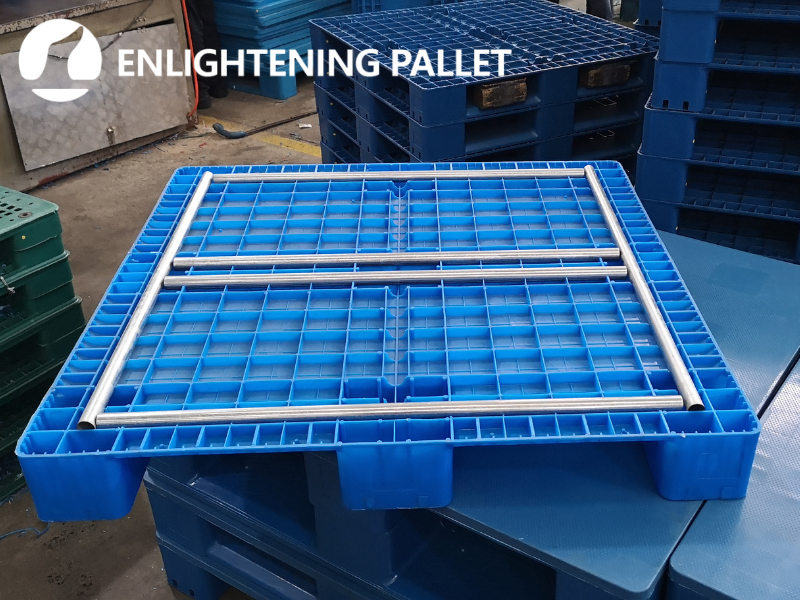
As a rackable pallet manufacturer, we usually recommend a steel-reinforced version once the pallet will be used on beam racking for demanding or long-term storage conditions. That is not about adding cost for the sake of it. It is about helping you keep better rack stability and reducing long-term deformation risk.
What You Should Check Before Choosing a Rackable Plastic Pallet
Before you make a final choice, there are a few things worth checking carefully.
First, confirm that the pallet has a real rack load rating, not just a high floor load value.
Second, check whether the rack load data comes from a test report with clear conditions and standard references.
Third, make sure the pallet dimensions and runner span actually fit your beam spacing and rack layout.
Fourth, check whether the deck style and bottom support design match your load type. If your goods are dense, irregular, or more likely to sit unevenly, that should affect the pallet you choose.
Fifth, think about your working environment. Long storage periods, temperature changes, and repeated forklift handling all affect real pallet performance over time.
And finally, do not assume that two pallets with the same size will give you the same rack result. Structure, stiffness, material, and support design can make a big difference.
Conclusion
If you use pallets on racking, the pallet rack load capacity is never just about the rack. It is also about how your pallet supports the load, how your goods are placed, and how the whole system performs over time.
The safest approach is to look beyond a single load number. Check the support condition, verify the test basis, and match the pallet structure to your real rack setup. If you do that, you are much more likely to choose a plastic pallet that not only meets the load requirement on paper, but also stays stable and dependable in your actual warehouse use.
That matching process is exactly what we do. With over 25 years of plastic pallets manufacturing experience and more than 60 injection and rotational molding machines in production, we work from your rack type, beam spacing, unit load, and storage conditions — not from a catalog. Where the application demands it, we can recommend steel-reinforced runners for higher deflection resistance, solid-top decks for off-center load stability, or specific material grades for temperature-sensitive environments. Every recommendation is backed by third-party tested load data, not self-declared figures.
If you have a rack setup and a load requirement, we can help you identify the right pallet specification before you commit to a bulk order.
Contact us to discuss your rack and load requirements!