What is a Block Pallet?
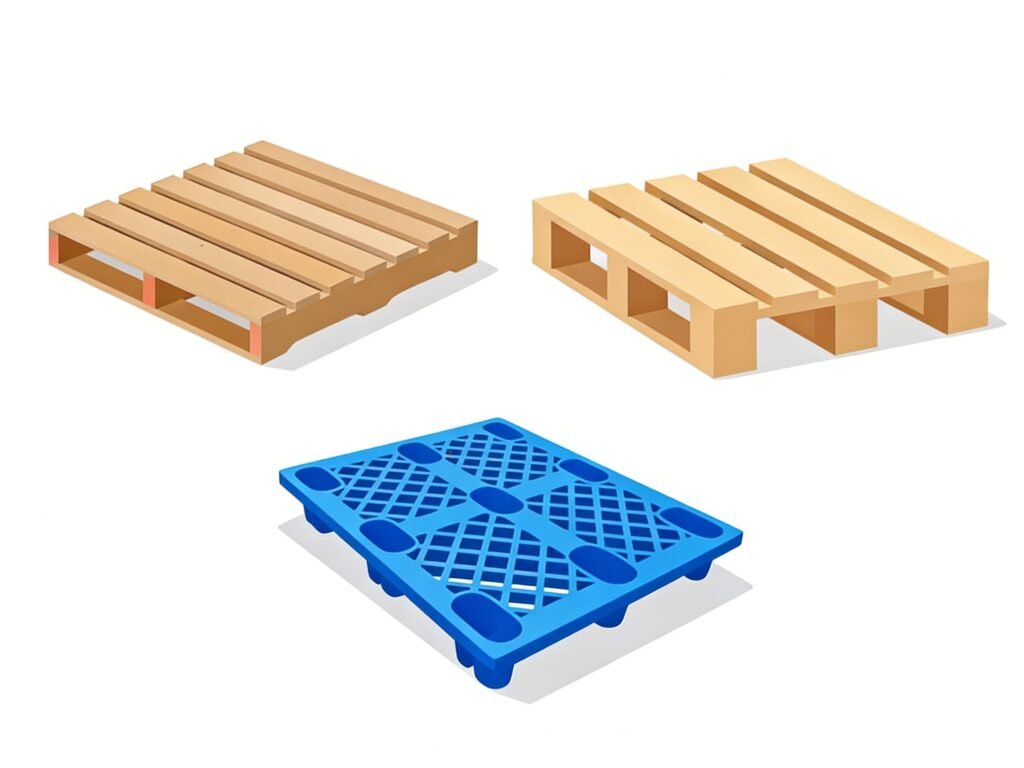
Block pallets are built for heavy loads and high-cycle operations. The defining feature is nine wooden or plastic blocks arranged across the bottom deck — four corners, four mid-edges, one center. Those blocks create open channels on all four sides, giving forklifts and pallet jacks four-way entry. That’s exactly why block pallets are a go-to in tight aisles and multi-directional stock rotation.
But a block pallet isn’t just a top deck sitting on nine blocks. A complete one typically includes a bottom deck, stringer boards, and either a perimeter frame or parallel base boards. Everything is nailed together — a fundamentally different construction logic from plastic pallets, which are typically molded as a single unit or welded.
The base configuration isn’t limited to nine blocks alone. You’ve also got three common layouts to choose from:
- 9 blocks + parallel base (continuous longitudinal boards): the alternating board direction allows interlocking nested stacking, which saves real space during transport
- 9 blocks + perimeter frame (full boundary frame around the base): the full bottom contact surface makes it a better fit for heavy-load handling
- 9 blocks + cruciform (cross-shaped base): the cross structure provides more complete bottom coverage, making it better suited for automated conveyor lines
What is a Stringer Pallet?
Stringer pallets run on a straightforward design: 3 continuous stringers running the full length of the pallet — left, center, right — directly supporting the top deck. Simple to build, cost-effective to produce. That’s why stringer pallets dominate the North American market, accounting for roughly 80% of pallet usage.
Because the stringers form solid walls on both sides, there’s no room for forks to enter from the sides — stringer pallets are standard 2-way entry. That said, most designs address this with 1 of 2 modifications:
- Notched stringers — cutouts along the stringer allow pallet jacks to enter from the side
- Chamfered entry — angled cuts at the stringer ends help guide forklift tines in cleanly
Stringer pallets are the right call for standard shipping and conventional warehouse operations, especially where cost efficiency matters more than 4-way flexibility:
- Factory-to-warehouse full-pallet shipments
- Standard point-to-point distribution from warehouse to dealer
- Routine handling that doesn’t require complex multi-directional access
- Projects where procurement efficiency and standardized shipping take priority
Difference Between Block Pallets and Stringer Pallets?
We’ve covered both types above. Here’s how they compare on a few more dimensions that actually matter when you’re making a sourcing decision.
1. Lifespan and Reuse Logic Difference
Block pallets generally outlast stringer pallets. Multi-point support distributes the load more evenly, which reduces concentrated wear over repeated cycles. Stringer pallets take more localized stress at each fork entry — and that adds up fast in high-cycle operations.
In practice:
- Stringer pallet: typically 3–5 cycles
- Block pallet: typically around 20 cycles
The reuse logic follows: stringer pallets are a natural fit for one-way shipping. If your pallets need to handle repeated transfers across multiple supply chain legs, block pallets are the more durable call.
2. Repairability Difference
Stringer pallets are easier to repair. A few stringers, a top and bottom deck — the structure is simple, and so are the failure points: split deck boards, a cracked stringer, worn notch areas. Find the damage, swap the part, move on.
Block pallets are a different story. Multiple blocks, top and bottom decks, and a base structure all working together means damage rarely stays contained. When several support points go at once, you’re looking at more components, more labor, and a higher repair bill.
3. Weight Difference
Same size, similar wood specs — block pallets will run heavier. More blocks, more base structure, more material overall. Stringer pallets keep it lean: a few continuous stringers do the job, and the weight stays manageable.
What that means in practice: block pallets give you more stable support and better long-term durability, but they add weight to every empty return. Stringer pallets are lighter and cheaper upfront — a better fit when outbound shipping cost is the priority.
Worth noting: wooden pallet weight shifts with wood species, moisture content, and build style. Plastic pallets don’t have that variability — every unit weighs the same, every time.
For the rest of the comparison, here’s a full breakdown across all the key specs:
| Stringer Pallet | Block Pallet | Plastic Pallet | |
| Lifespan | 3–5 cycles | ~20 cycles | 5–10 years |
| Structure | 3 continuous stringers + top deck | 9 blocks + top/bottom deck + base | Molded or welded single unit |
| Fork Entry | 2-way (4-way with notching) | 4-way | 2-way or 4-way |
| Best For | One-way shipping, standard distribution | Closed-loop, multi-transfer, racking | Food, pharma, export, automated lines |
| Cost | Low | Medium | Higher upfront, lower long-term |
| Certifications | ISPM 15 (export) | ISPM 15 (export) | No ISPM 15 required |
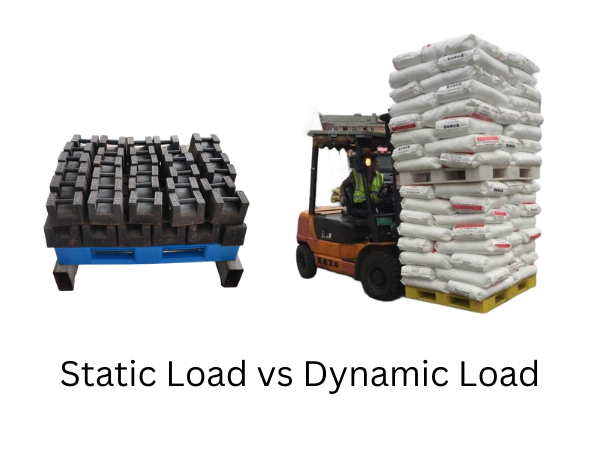
| Static Load | 1,500–3,000 kg | 3,000–5,000 kg | 2,000–8,000 kg |
| Dynamic Load | 1,000–1,500 kg | 1,500–2,500 kg | 1,500–3,000 kg |
| Racking Load | 800–1,200 kg | 1,200–2,000 kg | 1000–2,000 kg |
When to Choose a Block or a Stringer in 5 Steps
Step 1: How does your operation handle pallets?
If your facility runs frequent multi-directional fork entry, multi-leg transfers, or forklifts accessing from different angles — block pallets are the stronger fit. If it’s straightforward in-facility movement, fixed-direction entry, and low-cycle handling, a stringer pallet usually gets the job done.
Step 2: What’s the load profile?
Heavy loads, full-pallet weights, or concentrated load distribution — we’d lean toward block pallets. Light-to-medium loads with even weight distribution and a stable center of gravity? Stringer pallets are worth putting on the table.
Step 3: Are these pallets going into racking or long-term storage?
If your pallets are going up on rack — or sitting in the warehouse for extended periods — this step matters. Block pallets hold up better under racking conditions and maintain structural integrity over longer dwell times. If you’re running ground-level stacking with fast turnover, stringer pallets are typically more cost-effective. The structure is proven, supply is widely available, and cost is easier to control.
Step 4: One-way export or closed-loop reuse?
For one-way shipments, single-direction export, or low-recovery operations where pallets aren’t coming back — stringer pallets are the standard choice. They balance upfront cost and basic functionality well for projects where longevity isn’t the priority.
If your pallets cycle through multiple recovery rounds, multi-site rotation, or repeat deployment across your network, block pallets make more sense. When pallets are moving between plants, DCs, and customer facilities on a regular basis, the lifespan advantage and structural consistency of block pallets starts to pay off.
Step 5: What does your receiver require?
If your customer, retailer, 3PL, or receiving warehouse has specific pallet requirements — platform compatibility, fork entry direction, dimensions, acceptance standards, or a designated pallet style — lead with their specs, not the inherent characteristics of block vs. stringer. Their requirements override the general selection logic. And if neither block nor stringer can meet your customer’s standards, that’s already a signal worth paying attention to.
One Common Misconception: Block Pallet Isn’t Automatically Better Than Stringer Pallet
A lot of people assume block pallets are simply the better option across the board. In our experience, that’s not always true — and it’s worth being direct about why.
A block pallet with structural design gaps, lower-grade lumber, poorly secured blocks, inconsistent manufacturing, or loose fastener standards can easily underperform a well-built stringer pallet. So before you default to “just get block pallets,” here’s what you actually need to look at when evaluating any wooden pallet supplier: design capability, lumber and material controls, assembly quality, nailing and fastener standards, dimensional consistency, and production stability. Those factors will tell you more about real-world performance than pallet type alone.
But, even if you get the pallet type right and your supplier checks out, wooden pallets — block or stringer — still come with a set of problems that don’t go away no matter how well they’re made:
- Splinters and debris are a real issue, especially in food and ag environments — they compromise packaging integrity and create handling hazards for your team
- Nail pops, board splits, and edge damage show up regularly, and each one means repair time, pallet swaps, and extra labor
- Moisture content fluctuates — in cold chain or variable environments, that affects both weight and dimensions, which can throw off your equipment specs
- Over time, structural wear shows up as jams on automated lines and slower throughput across your facility
- You can’t pressure-wash wooden pallets — in high-hygiene environments, contamination usually means replacement, not cleaning
- Damage compounds on wood — one bad board leads to more, and you end up in a cycle of patching that never really ends
- Empty and damaged pallets pile up fast — they don’t nest, they take up floor space, and they keep degrading while they sit
- Batch-to-batch inconsistency creates friction in automated conveying, AS/RS systems, and standardized warehouse flows
- And when you factor in repair, replacement, downtime, and management overhead on top of purchase price, the total cost of ownership often looks very different than it did upfront
These are the day-to-day frustrations that push a lot of operations past the block-vs.-stringer conversation entirely — and toward plastic pallets. So why do plastic pallets often win out? The reasons are pretty straightforward:
- More structurally consistent — no cracking, no debris, no nail pops
- Tighter dimensional tolerances — better fit for automated systems, conveyors, AS/RS, and standardized warehouse operations
- Easy to clean — pressure-washable and sanitation-compliant, which makes a real difference in high-hygiene environments
- Longer reuse lifespan — built for closed-loop and high-turn operations
- Lower maintenance demand — fewer repair cycles, fewer mid-operation failures
- Clearer long-term cost logic — especially in large retail, food, pharma, automated warehousing, and high-frequency distribution
- Better presentation — consistent appearance across every unit and every cycle, which matters as your assets and operation grow
- Recyclable at end of life — the material goes back into production, not the landfill
- Better ROI over time — we’ve run the numbers on plastic pallets lifespan and total cost, and plastic pallets regularly come out ahead of wood
At some point, it’s worth asking yourself: is your current pallet platform actually built for where your supply chain is heading?
In Conclusion
If you’re ready to move beyond the repairs, inconsistency, and short service life that often come with wood pallets, you’re not alone—more than 500 customers have already made that switch with us. At Enlightening Pallet, we offer lightweight, recyclable plastic pallets with consistent quality and a service life of up to 10 years, giving you a more stable long-term solution for storage, handling, and transport. You can also compare the total cost of your current wood pallets and calculate the ROI of switching to plastic. To learn more, call us at +86 150 6629 1772, email our specialist at Joy@cnplasticpallet.com, or visit our contact page.